
Someone has a question about the thing you sell. They type it into Google or ask an AI chat tool, and a few seconds later they get an answer pulled from somebody’s website.
You’d like it to be yours.
That’s answer engine optimisation (AEO) in a sentence. Ranking on page one still matters a great deal. AEO pushes a little further and tries to get your content quoted, summarised or linked inside Google’s AI Overviews, AI Mode and the AI chat tools a lot of people now use without thinking twice.
Take a hawker-style F&B brand. Or a neighbourhood reno contractor, or a logistics company running a couple of warehouses out in Tuas. They don’t have much in common, but they all want to turn up when a likely customer asks about their kind of work.
This guide covers what AEO is, how it fits with SEO and GEO, how to optimise for answer engines, and what you can reasonably expect from an AEO agency in Singapore.
A Quick Note: “AEO” Also Means Something Else in Singapore
Type “AEO Singapore” into a search bar and you’ll probably get customs and trade pages mixed in with the marketing ones. In trade, AEO is short for Authorised Economic Operator. Singapore runs this through the Secure Trade Partnership (STP and STP-Plus), which Singapore Customs describes as “a voluntary certification programme consistent with the World Customs Organisation (WCO) SAFE Framework of Standards”. If certification or the application process is what you came for, the Singapore Customs STP page is the one to read.
Everywhere else in this article, AEO means answer engine optimisation. Search marketing, not shipping.
What Is Answer Engine Optimisation (AEO)?
An answer engine is a search tool that gives you an answer instead of a bare list of links. Google’s AI Overviews and AI Mode are answer engines. So are voice assistants and AI chat tools that can look things up on the web.
AEO takes ordinary SEO practice and uses it to help these tools find your content, understand it and trust it enough to use it. In day-to-day terms, that mostly means writing straight answers to the questions customers really do ask, on pages search engines can crawl, index and show as snippets. It also means putting in first-hand detail (the kind generic copy can’t fake) and keeping your business information consistent wherever it’s listed.
Google’s guide to optimising for generative AI search is plain about this: “From Google Search’s perspective, optimising for generative AI search is optimising for the search experience, and thus still SEO.”
So AEO is SEO, with more care taken over answering people properly.
AEO vs SEO vs GEO: What Singapore Businesses Need to Know
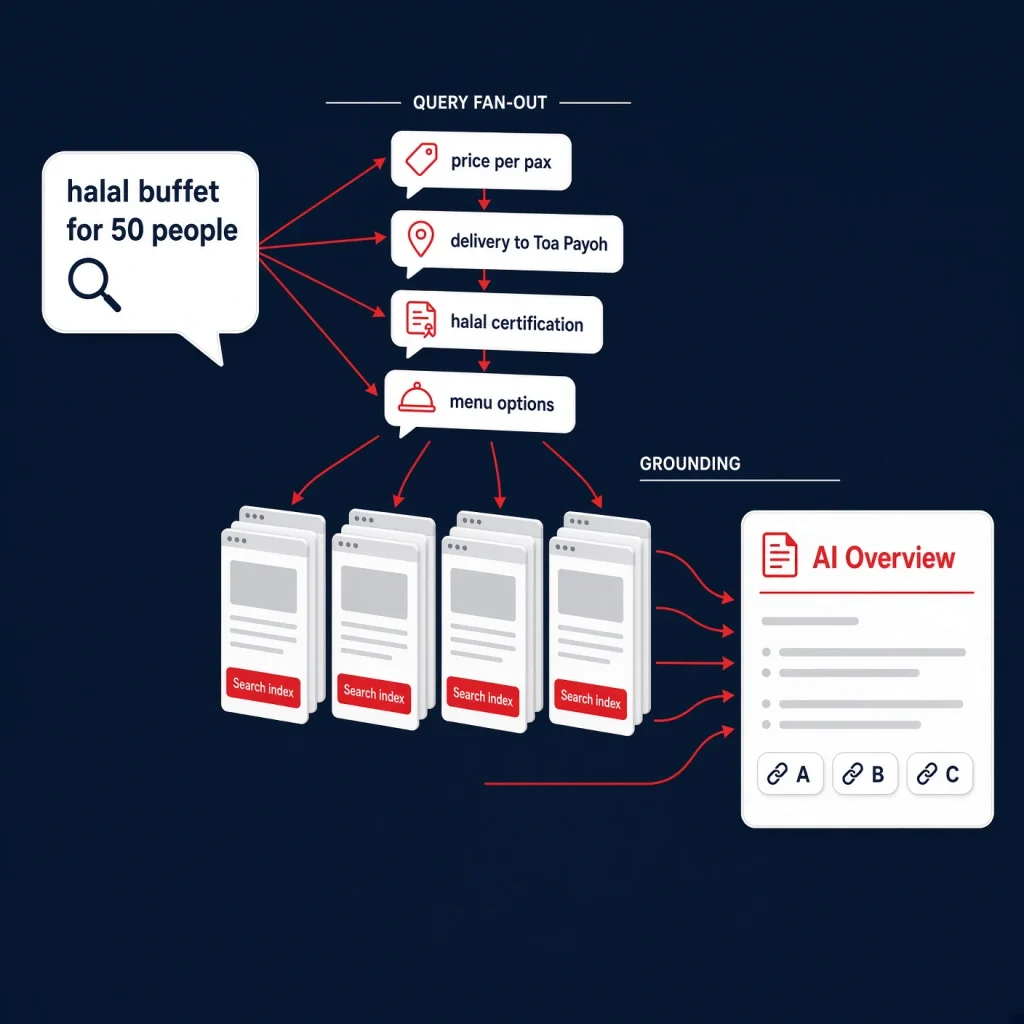
You’ll hear the three acronyms used almost interchangeably. They overlap a lot but aren’t identical, and here’s how we tell them apart.
| SEO | AEO | GEO | |
| Stands for | Search engine optimisation | Answer engine optimisation | Generative engine optimisation |
| Main goal | Rank your pages in search results | Be the direct answer to someone’s question | Get cited or mentioned when AI writes a response |
| Where it shows up | Google’s regular results and Maps | AI Overviews, AI Mode, featured answers and voice | AI chat tools and other AI search experiences |
| What it relies on | Crawlable, useful pages, good links, a technically healthy site | All the SEO basics, plus clear answers built around questions | SEO basics again, and a brand people trust across the web |
| How you measure it | Rankings, clicks and enquiries | Search Console data and a watch-list of key questions | Mentions and citations in AI answers; referral traffic |
If Google is the main thing on your mind, our guide to AIO services for Singapore businesses has a lot more on AI Overviews in particular.
Why Google Says AEO Is Still SEO
Google’s AI features documentation is about as direct as documentation gets: “The best practices for SEO remain relevant for AI features in Google Search (such as AI Overviews and AI Mode). There are no additional requirements to appear in AI Overviews or AI Mode, nor other special optimisations necessary.”
That’s good news for most Singapore SMEs. Nobody needs a separate “AI website”. You need a decent site that’s built around what your customers keep asking, and that’s why we treat AEO SEO in Singapore as one plan instead of a pricey extra.
How AEO Works in AI Overviews, AI Mode and AI Chat Tools
Very loosely, AI-powered search engines look for pages that might answer the question, work out what each one says and then pick the ones they’ll use.
They need to be able to reach your page.
Google states that “To be eligible to be shown in generative AI features on Google Search, a page must be indexed and eligible to be shown in Google Search with a snippet”. If your page is blocked, isn’t indexed or has its snippet restricted, Google’s AI answers can’t use it.
Other AI search tools have their own crawlers.
Chat tools that search the web send out their own bots. OpenAI, for one, documents separate crawlers for search and for model training in its bots documentation. In our audits we go through robots.txt, firewall rules and CDN settings to check that the search bots of the AI tools you care about aren’t being shut out by accident.
They prefer content that answers the question clearly.
In Google’s words, AI Overviews “help people get to the gist of a complicated topic or question more quickly”. A page that gets to the answer near the top of the relevant section is much easier to use than one that buries it under five paragraphs of preamble.
How to Optimise for Answer Engines: 5 AEO Strategies for Singapore Businesses
The following 5 steps are practical ways to help answer engines find and use your content. We don’t promise any “tricks”. Standard good SEO practice, built into an AI SEO strategy, works here the same way it already does for regular search, by targeting the questions people type into search engines.
1. Write Localised, Authoritative Answers
AI tools can summarise generic content within seconds, so there’s little value for them in using yours. Local, first-hand knowledge is much harder to copy.
Google also points out: “Don’t just recycle what others on the internet have already said, or could easily be produced by a generative AI model.”
This could be a tuition centre explaining how its classes relate to the current MOE syllabus and the PSLE timing. A home renovation company could explain how long an HDB kitchen renovation would take, with a breakdown of what happens at each stage, based on similar projects it has done. A logistics company could explain what happens to a shipment from the time it reaches the warehouse, and so on.
If you’re unsure whether you’re covering all the questions your prospective customers are asking, an AI content gap analysis for your SME can help.
2. Use Structured Data That Matches the Page
Google doesn’t need you to add any special structured data for generative AI search. It’s still worth marking up the usual details about your business, such as opening hours, services offered, contact information and customer reviews, as part of your normal SEO.
Google states: “Structured data isn’t required for generative AI search, and there’s no special schema.org markup you need to add. However, it’s a good idea to continue using it as part of your overall SEO strategy, as it helps with being eligible for rich results on Google Search.”
The best rule to remember is to only mark up information that visitors can see on your website, and to keep it accurate and up to date. For example, if a restaurant’s schema markup says it closes at 10 pm on weekends, its website and its Google Business Profile must say the same.
3. Answer Conversational Questions Directly
People searching for answers online usually ask questions the way they’d talk to a friend or family member. A typical question for an answer engine would be “Where can I get halal dim sum near Tampines that’s open late?”
You can deal with this naturally. Turn real customer questions into subheadings, give the direct answer in the first couple of sentences below each one, and then add the rest of the detail. Also anticipate follow-up questions, and include information on price, timing, location and whether the customer qualifies.
Remember that Google warns that creating content for every possible variation of a question “primarily to manipulate rankings or generative AI responses in Google Search violates Google’s scaled content abuse spam policy”. It’s much more effective to create one strong page on a topic than 10 weak pages on the same topic. Our posts on AI keyword research and voice search optimisation cover more on finding and answering these questions.
4. Show Experience and Trust (E-E-A-T)
E-E-A-T stands for experience, expertise, authoritativeness and trustworthiness. Answer engines lean on trust signals when they choose which sources to rely on, so make yours easy to see:
- Make sure the author of the content is clear, with relevant credentials and a short bio
- Your UEN, address and contact details, shown clearly
- Real photos of yourself, your team, your premises and your work
- Genuine reviews from customers on your Google Business Profile
- In regulated industries (e.g. finance, health, law), claims that are 100% accurate
If you work in a regulated industry, we’ve also written a separate guide to compliant AI SEO content.
5. Add Useful Images and Video
Answer engines don’t only show text. Google notes that its “generative AI search features can bring in relevant images and video, which means more opportunities for your website to appear beyond web page links.”
This could be a short video of your product being made, or a simple photo of a finished reno. Images and videos like these can earn visibility that a page of words alone might not. Give your image files meaningful names and add proper alt text to them.
How to Measure AEO Results

AEO is messier to track than rankings. An answer can help a customer who never clicks through to your site at all.
We start in Google Search Console. Google recommends using “the Generative AI performance report in Search Console” to see how your content does in its generative AI features, and we look at that next to the usual Performance report for clicks, impressions and queries.
Then we keep a question watch-list. Write down the 20 to 50 questions your Singapore customers ask most often and check every so often whether your business gets mentioned or linked in the answers from the tools that matter to you. It’s manual work and a bit tedious, but it tells you a lot.
We check analytics for visits referred by AI chat tools as well.
The part that matters most is the commercial one: are more calls, WhatsApp enquiries, bookings or orders coming in?
Be careful with tools. Google says, “No third-party tool has access to our internal ranking or AI systems.” AI visibility tools can help you spot trends. Just read their figures as estimates and not as Google data.
Common AEO Mistakes and Myths to Avoid
Myth 1: You need an llms.txt file for Google Search. You don’t. In Google’s words, “You don’t need to create new machine-readable files, AI text files, or markup to appear in these features.”
Myth 2: Your content has to be “chunked” for AI. Google puts chunking content on its list of tactics you can safely ignore. Write for people and use sensible headings. That’s enough.
Myth 3: Buying mentions will get you into AI answers. According to Google, “seeking inauthentic ‘mentions’ across the web isn’t as helpful as it might seem.” Paying for fake reviews or forum posts can also damage your reputation, which is a real cost on top of the wasted money.
Myth 4: You need to write specially for generative AI search. Google says, “You don’t need to write in a specific way just for generative AI search.” Use the words your customers use, as you would for any search, and write for the people reading.
Mistake 5: Inconsistent business information. Your opening hours, address and prices should match on your website, your Google Business Profile and any directory listings. If they don’t, AI tools might repeat the wrong details or leave you out.
Mistake 6: Expecting guarantees. Google’s guidance on third-party SEO services and tools notes that “using a service or tool doesn’t guarantee ranking success”. We’d steer clear of any AEO company in Singapore that promises your business will show up in AI answers.
What an AEO Agency in Singapore Should Do for You
If you’re comparing AEO services in Singapore, good work usually includes most of this.
- An audit that looks at crawlability, indexing, snippet settings, robots.txt and AI crawler access, site speed and structured data.
- Question research to find out what your Singapore customers really ask, in their own words, and which page ought to answer each question.
- Content improvements on the key pages, so they answer clearly and have first-hand, local detail in them.
- Trust and entity work. That means getting your business information consistent on your site, Google Business Profile and listings, and having an honest way to collect reviews.
- Measurement that starts from a baseline, uses a question watch-list and reports on enquiries as well as rankings.
- Honesty about what nobody can control. No guaranteed placements.
It also pays to know how providers price this work and what to ask an AI SEO agency before you sign.
Frequently Asked Questions
What is answer engine optimisation (AEO)?
It’s the work of getting your web pages picked as the answer when search engines and AI tools respond to people’s questions. Usually that means direct answers, pages search engines can crawl and index, first-hand content, and business details that are accurate and the same everywhere.
Is AEO the same as SEO?
Close, but not quite. SEO gets your pages into search results. AEO tries to make them the direct answer to specific questions in AI Overviews, AI Mode and AI chat tools. Google says optimising for generative AI search is still SEO, so AEO builds on good SEO. It doesn’t replace it.
What is the difference between AEO and GEO?
AEO is about being the answer to fairly specific questions. GEO (generative engine optimisation) is broader and looks at how often you get mentioned and cited in AI-generated content, AI chat tools included. Both depend on crawlable pages, first-hand content and business information that’s current and consistent.
Is answer engine optimisation the same as Singapore Customs’ AEO certification?
No. In trade, AEO stands for Authorised Economic Operator, and in Singapore that falls under Singapore Customs’ Secure Trade Partnership (STP and STP-Plus). Answer engine optimisation is a search marketing practice. If you need customs certification, go to the Singapore Customs STP page.
How do I measure or track AEO performance?
Start with the Generative AI performance report in Google Search Console. Keep a watch list of customer questions and check it now and then. Look for referral traffic from AI tools in your analytics, and keep an eye on enquiries and sales, because those are what count.
Do I need special schema or an llms.txt file for AEO?
Not for Google Search. Google says no special schema.org markup is needed for generative AI search, and you don’t need AI text files like llms.txt either. Normal SEO does the job, as long as your structured data matches what’s visible on the page.
How long does AEO take to show results?
There’s no fixed timeline. It depends on where your site’s starting from, how competitive your market is and how quickly changes get made. Nobody can guarantee a page will be picked for an AI answer.
How much do AEO services cost in Singapore?
That depends on how big your site is, how much content needs work, and whether you want a one-off audit, ongoing support or both. For pointers on what to watch for when buying, read our guide to AI SEO in Singapore: SEO, GEO and how to buy them.
Final Thoughts and Next Steps with The Leading Solution
AEO isn’t a new trick. It’s good SEO, adjusted for answers.
Decent SEO has always been built on clear answers, local detail, accurate information and a site search engines can read. That’s as true for AI search optimisation for SMEs as it is for bigger brands, whether you run a family bakery in Joo Chiat or a freight forwarder in Jurong. The job is still to answer your customers’ questions properly.
We’ve been doing SEO for Singapore businesses since 2015, making sure our clients get optimal visibility in their niches. We’ll be upfront about what we can do for you, and about what we can’t.
About The Director
Notable Achievements

Struggling to Attract More Traffic?
Let us help! We provide various digital marketing services that can easily rank your website on the first page of Google such as:
Allow your website to be seen by more users by scheduling an appointment with us today!