
Most website SEO packages in Singapore look overly polished. They include traffic projections, keyword forecasts, and long lists of deliverables. But once you delve deeper and start comparing them, the differences narrow and confusion sets in. Some agencies emphasise backlinks. Others promise rapid rankings. Some bundle web design and call it “SEO-ready”. Very few break down what their website services involve — and even fewer explain how they will help businesses grow sustainably.
Luckily, understanding the fundamentals will help you evaluate website SEO services in Singapore more accurately. From learning about its different aspects to the ways to assess agencies properly before hiring one. After all, professional SEO services in Singapore should not rely on vague deliverables. They should operate from a structured methodology.
What Does “Website SEO” Actually Include?

The term “website SEO” often gets used loosely. To some, it means adjusting meta tags, while for others it involves content creation or simple technical clean-up.
In practice, structured website SEO services should include five interconnected layers.
1. Technical SEO Foundation
Without technical stability, optimisation stalls. Google’s own Search documentation emphasises crawlability and site structure as foundational ranking elements (see Google Search Central guidance).
If an agency skips technical review and moves straight to keywords, you are not evaluating full-scope SEO. You are evaluating partial optimisation.
A proper audit should examine:
- Crawlability and indexation
- Site architecture
- Core Web Vitals
- Mobile responsiveness
- Structured data
- Page performance
2. On-Page Optimisation
Search engines increasingly reward structured clarity. Pages that read logically for users and are easy for Google to interpret tend to perform better in search results. That’s why every on-page rework should go beyond inserting keywords.
Effective website SEO optimisation involves:
- Search intent alignment
- Clear heading hierarchy
- Internal linking strategy
- Metadata clarity
- Contextual semantic relevance
3. Content Strategy
Many businesses underestimate content architecture. Yet industry data suggests this is a critical aspect of SEO, which is often decisive for a brand’s success or failure. Research from Ahrefs indicates that over 90% of web pages receive no organic traffic from Google.
The most common problem businesses face is a lack of clear search intent alignment, a structured content cluster, or both. Strong SEO often includes structured content planning and, where necessary, specialist services such as SEO copywriting services.
Strategic content work may include:
- Keyword clustering
- Buyer-stage mapping
- Informational and commercial layering
- Internal content linking
4. Authority & Link Signals
Relevance is still number one when it comes to authority and industry data shows that the number of referring domains correlates strongly with higher rankings. Vice versa, pages ranking higher usually have more backlinks than lower-ranked pages.
In this regard, you should be extremely cautious of agencies offering fixed monthly backlink packages. After all, SEO is not a link subscription service and no one can guarantee an X number of backlinks in a limited timeframe.
Instead, authority building should focus on:
- Editorial placement
- Contextual integration
- Industry relevance
- Natural link velocity
5. Ongoing Website SEO Management
Search evolves constantly. Algorithm updates, AI summaries, and shifting user behaviour demand continuous refinement. A one-off optimisation campaign often results in early gains followed by stagnation.
A typical site management should include:
- Regular audits
- Performance testing
- Competitor monitoring
- AI search adaptation
How to Assess an Agency’s Website SEO Approach
Once you understand scope, the next step involves evaluating depth. To check whether an agency is fit for your needs, you must ask the right questions regarding their website optimisation strategy:
Do You Begin With a Technical Audit?
Credible agencies diagnose before prescribing. If the conversation begins with “We can rank you first” without reviewing your site’s condition, that is a red flag.
Is the Strategy Data-Led?
Strong website SEO in Singapore typically involves:
- Competitor gap analysis
- Keyword clustering
- SERP feature mapping
- Industry benchmarking
Templates rarely deliver sustained performance.
Who Handles the Strategy?
Ask directly. Is it senior-led? Or delegated entirely to junior staff? Clarity here prevents later misunderstandings.
How Should You Measure Website SEO Performance?
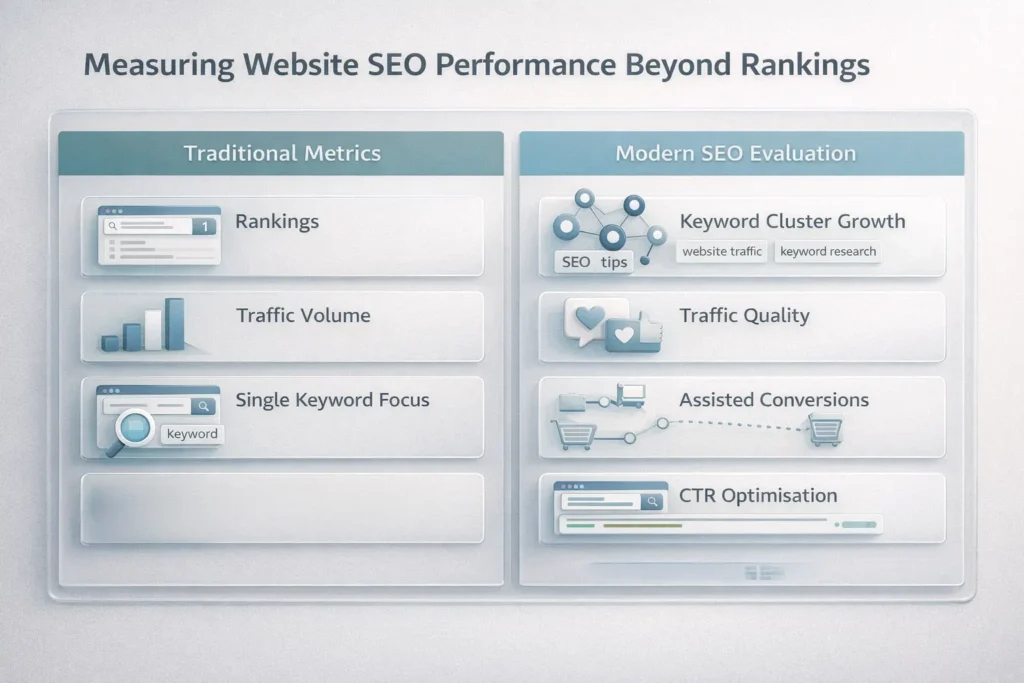
Rankings still matter. But they no longer define success on their own. AI search features are becoming increasingly prominent, prompting agencies to adapt to structured content extraction and entity recognition. This shift requires employing advanced AI SEO strategies to ensure sustainable results with real revenue — not just impressions.
Modern SEO performance should include:
- Keyword spread across clusters
- Traffic quality
- Assisted conversions
- Engagement signals
- Click-through rates
- AI Overview visibility
Why Website SEO Pricing in Singapore Varies So Much
SEO pricing often causes confusion because scope differs significantly between agencies.
Some engagements focus narrowly on technical clean-up. Others include structured content production, authority building and ongoing strategic optimisation.
Before comparing proposals, ensure you understand SEO pricing in Singapore to set realistic expectations.
Keyword Spread Across Relevant Topics
Strong SEO does not rely on one or two high-volume keywords. Instead, it should include long-tail variations and a broad topic coverage across different clusters.
Google’s Search Essentials documentation emphasises crawlability, structured content and relevance — all of which reinforce the importance of clear topic coverage and logical architecture.
A healthy SEO campaign typically shows:
- Growth in total ranking keywords
- Expansion into long-tail and related queries
- Increased impressions across broader search sets
You can observe this directly in Google Search Console under the “Queries” report.
Sustainable growth usually comes from cluster expansion, not isolated rankings.
Traffic Quality
Traffic volume alone does not indicate performance. Even if it increases, declining engagement often indicates a mismatch between search intent and the content. This corresponds with Google’s priority on helpful, high-quality content, reiterating the “quality over volume” concept.
Google Analytics data should reveal:
- Logical session duration
- Page depth
- Meaningful user journeys
- Engagement on commercial pages
Assisted Conversions
Organic search often influences decisions before the final click. If SEO consistently appears in assisted conversion paths, it demonstrates measurable commercial influence beyond basic click counts.
In GA4, assisted conversions show how organic traffic contributes to outcomes even when it is not the last-touch channel.
For example:
- A user discovers your website through a blog article.
- Returns later via branded search.
- Converts through a direct visit.
Engagement Signals
Google does not publicly confirm using bounce rate directly as a ranking factor. However, it does measure user satisfaction indirectly through interaction patterns. When users quickly return to search results (often referred to as “pogo-sticking”), it may indicate dissatisfaction. That’s why search systems attempt to minimise through quality signals.
Engagement indicators such as:
- Scroll depth
- Time on page
- Internal navigation
- Repeat visits
help reveal whether content meets expectations.
Click-Through Rates (CTR)
Ranking position alone cannot guarantee traffic volume. A page ranking third with a compelling title and structured meta description can outperform a first-ranked result with weak messaging.
Google Search Console provides measurable CTR data by query and page.
Improving CTR can increase traffic without improving rankings — making snippet optimisation and title refinement part of performance strategy.
In competitive Singapore SERPs, marginal CTR improvements often produce meaningful traffic gains.
AI Overview Visibility
Search presentation continues to evolve.
Google now uses AI to generate summaries for different queries. When AI Overviews or featured snippets cite your content, it typically reflects strong structural clarity and topical alignment.
Pages optimised with:
- Clear definitions
- Structured headings
- Concise explanatory paragraphs
- Entity consistency
are more likely to be extracted by AI systems.
Visibility in these summaries may not always generate direct clicks, but it reinforces brand authority and discovery.
Agencies that still optimise purely for “Rank #1” overlook this structural shift in search behaviour.
Red Flags to Watch Out For When Hiring a Website SEO Agency
Certain patterns surface repeatedly in the local market.
Exercise caution if an agency:
- Guarantees specific rankings
- Skips a technical audit
- Offers fixed backlink quotas
- Cannot articulate methodology
- Avoids transparency in reporting
- Promises rapid, guaranteed outcomes
SEO involves variables outside any agency’s direct control. This is the reason why you should hire companies that set realistic targets.
Boutique Agency, Large Firm or Freelancer — What Fits Your Business?
No single structure suits every business. Instead of focusing purely on brand recognition, evaluate alignment, communication style and strategic depth. Knowing how to choose the right SEO agency in Singapore can help clarify evaluation criteria further. After all, fit matters as much as capability.
Below is a simplified comparison to help clarify trade-offs.
| Factor | Freelancer | Boutique Agency | Large Agency |
|---|---|---|---|
| Strategy Depth | Varies widely | Often senior-led | Structured but layered |
| Communication | Direct, flexible | Direct, consultative | Often account-managed |
| Scalability | Limited capacity | Moderate scalability | High scalability |
| Cost Structure | Lower upfront | Mid-range | Often higher retainers |
| Specialisation | Niche-dependent | Focused expertise | Broader service range |
| Reporting | May be basic | Structured & customised | Formalised reporting systems |
| Adaptability | Highly flexible | Strategically adaptive | Process-driven |
A Practical Checklist Before You Sign
Before committing to website SEO services in Singapore, confirm that you will commit that you’ll engage in a multi-month plan and that:
- A technical audit has been conducted
- Deliverables are clearly defined
- Reporting metrics align with business objectives
- Authority-building methods are transparent
- Pricing reflects realistic scope
- Strategy aligns with industry context
Final Thoughts
Choosing the right website SEO services is more than just sifting through price quotes. It requires understanding structure, methodology and strategic intent.
For business owners in Singapore, chasing quick wins often results in wasted time and effort. Those who refine their website methodically see slow but steady growth, driving organic traffic that actually converts.
If you prefer structured clarity before committing, a focused strategy discussion can help assess alignment, scope and long-term feasibility. You may submit an enquiry to explore whether the approach aligns with your growth objectives.
About The Director
Notable Achievements


Struggling to Attract More Traffic?
Let us help! We provide various digital marketing services that can easily rank your website on the first page of Google such as:
Allow your website to be seen by more users by scheduling an appointment with us today!