
AI SEO has moved fast. In less than two years, Google has gone from testing simple AI-generated answers to rolling out AI Overviews across search. What began as a mere productivity tool has now become a ranking shortcut and in some cases, a replacement for traditional SEO altogether. For Singapore businesses, answering “How effective is AI SEO?” creates uncertainty that requires quick action. First-movers expect more traffic, while those who are just catching up worry about losing relevance as Google’s AI answers expand.
For those already exploring AI SEO services, the more useful question is not whether AI SEO is “good” or “bad”, but whether it’s effective and effective in what sense. With the emergence of voice and zero-click and intent-based searches, rankings, traffic, and value no longer correlate the way they used to. Obviously, AI SEO is becoming more influential by the day, affecting traffic behaviour, and what the data suggests Singapore businesses should realistically expect. No hype. No shortcuts. Here’s what the numbers are saying:
What “AI SEO” Actually Means Today (And What It Does Not)
AI SEO has already become standard practice among early adopters, yet many businesses still struggle to understand what it can realistically achieve — and where its limits lie. For example, using AI doesn’t automatically guarantee rankings or preference from Google. In fact, Google’s guidance on AI-generated content has been explicit on this point — it evaluates content for usefulness, accuracy, and intent over the way it’s been produced.
In practice, AI SEO functions as an efficiency layer that speeds up research, helps structure content and finds technical and topical gaps. Still, trust, relevance and authority remain fundamental and decide where each page ranks. The new rules have shifted the focus on systematic planning and prioritisation, often through AI SEO planning for Singapore SMEs, rather than trying to automate SEO itself.
Does AI SEO Increase Traffic? What the Data Shows
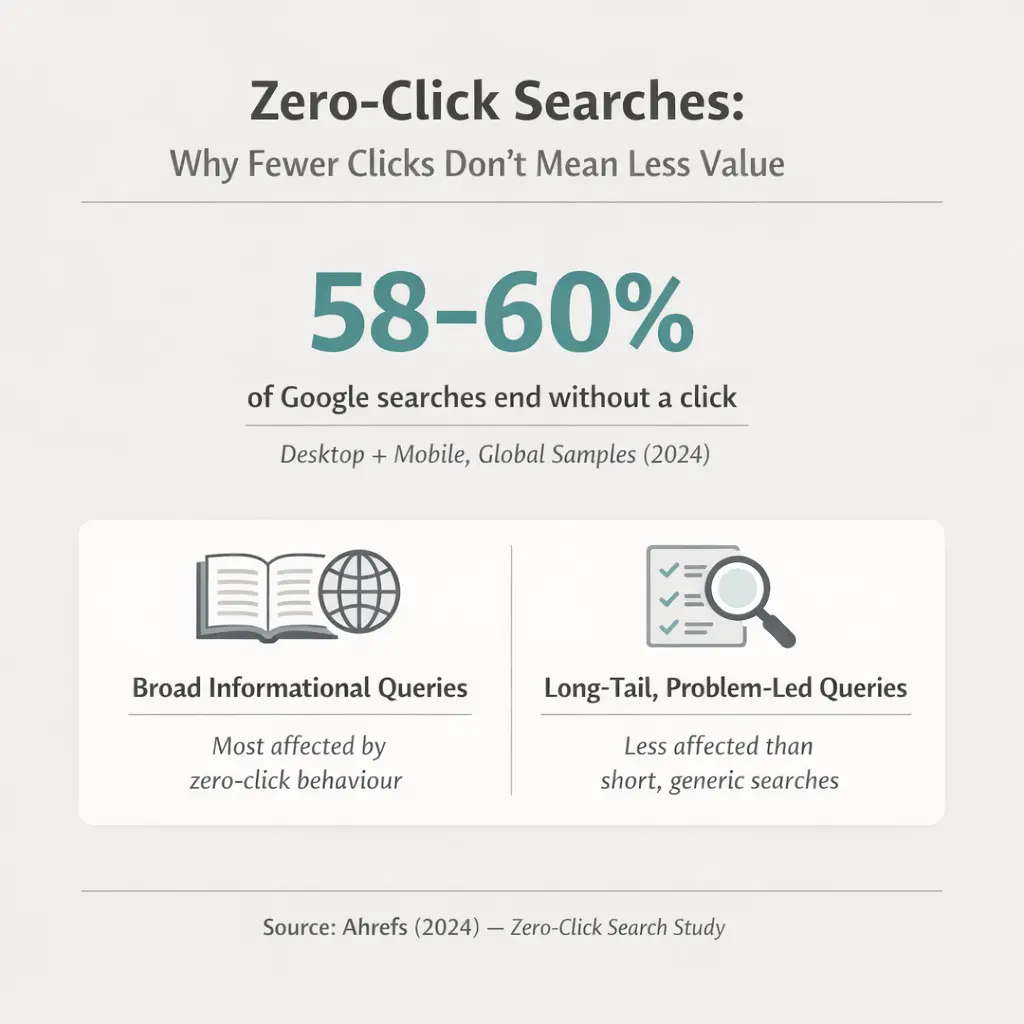
Recent large-scale analyses show the clear tie between AI-generated answers and rich SERP features and impressions. What’s surprising here is the reduced correlation with click-through rates, showing that in many cases, they decline even when rankings remain stable.
Ahrefs’ recent research on AI Overviews and organic CTR behaviour shows the pattern is already there – AI-generated answers improve visibility but user behaviour changes.
Google’s own documentation on impressions, clicks, and CTR reinforces this dynamic. A page can be shown more often without receiving more visits, especially when users obtain sufficient answers directly from search results.
This explains why many businesses feel conflicted. AI SEO may coincide with broader query coverage and stronger visibility, yet traffic growth slows or fragments. It also explains why discussions around SEO versus AI SEO have become more nuanced. The issue is no longer ranking alone. It is how value is captured after visibility.
AI SEO and Traffic Quality (Why Fewer Clicks Can Still Be Better)
Traffic volume is easy to measure. Traffic quality is not. AI-mediated search filters intent earlier, which means the users who still click tend to arrive with clearer expectations.
Ahrefs’ broader research into zero-click searches and SERP behaviour suggests that long-tail, problem-led queries increasingly drive smaller but higher-quality traffic pools. These sessions often show stronger engagement and higher downstream conversion rates.
In practical terms, AI SEO often reshapes traffic before it grows it.
For Singapore businesses operating in competitive markets, this matters. Fewer visits can still produce better outcomes if those visits are better aligned with intent.
Is AI SEO Worth It for Singapore SMEs? A Cost–Outcome View
Automation has allowed SMEs to remain on par with larger brands without increasing expenses. This is less about competing on scale and more about reducing wasted effort.
Thanks to AI, smaller businesses show an increase in productivity gains and faster decision cycles, rather than immediate revenue spikes. SEO follows the same pattern.
AI-assisted workflows reduce manual research time. They speed up iteration, effectively reducing budget costs. They help teams decide what not to publish.
One practical benefit is faster opportunity filtering. Many organisations now rely on AI keyword gap analysis to avoid investing in content that never performs, reallocating effort towards pages with clearer upside.
That said, AI SEO does not compensate for weak foundations like thin authority and poor site structure. Still, it can be an efficiency multiplier for Singapore businesses with stable fundamentals.
Where AI SEO Performs Best (And Where It Struggles)
AI SEO is not universally effective. Google’s own guidance makes clear that AI-assisted content does not bypass core ranking signals. In fact, AI delivers the most value in narrowly defined workflows rather than as a broad, all-purpose solution.
It performs best when the content:
- Addresses informational or comparative intent
- Solves specific problems clearly
- Benefits from structure, summaries, and evidence
- Remains evergreen rather than promotional
It struggles when:
- Keywords are purely transactional
- Domains lack trust or authority
- Content relies on volume rather than expertise
Prioritising compliant AI SEO content is crucial for ensuring accuracy, usefulness and proper sourcing. With the right editorial oversight, small businesses win long-term visibility that builds trust.
How Singapore Businesses Should Measure AI SEO Effectiveness
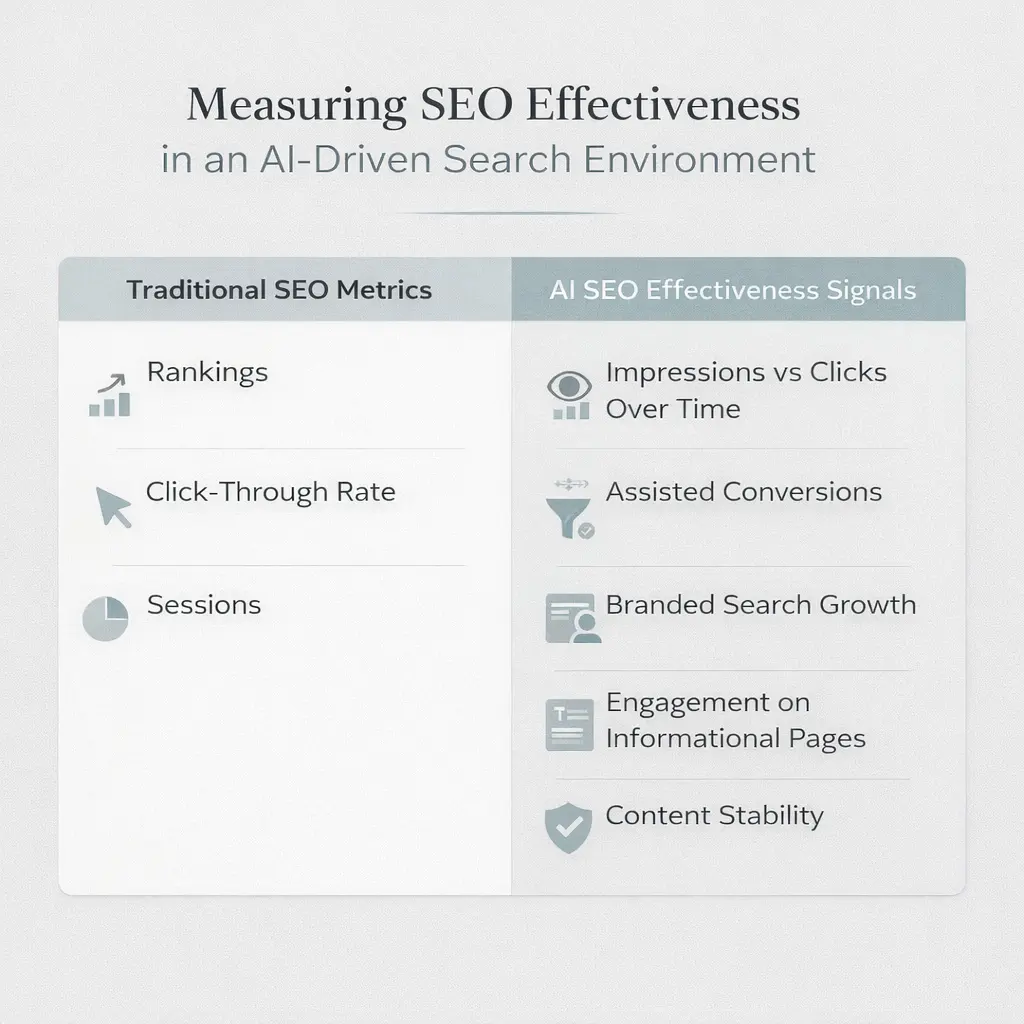
Rankings alone are no longer sufficient.
Effectiveness should be assessed through:
- Impressions versus clicks over time
- Assisted conversions, not just last-click attribution
- Growth in branded searches
- Engagement quality on informational pages
- Content longevity and stability
Google Search Console remains the most reliable lens for such analyses, showing that relying only on ranking movement often misses deeper shifts in user behaviour. On the other hand, measuring effectiveness increasingly depends on how well AI SEO strategies translate visibility into meaningful outcomes.
What AI SEO Will (and Won’t) Do in the Next 12–24 Months
AI-mediated discovery will continue to expand.
Forecasts from Gartner suggest a growing share of searches will be resolved without traditional clicks, particularly for informational queries. The entire shift in trends changes the role of SEO, pointing to a more realistic perspective:
- AI SEO does not replace fundamentals.
- It does not guarantee traffic.
- It does not eliminate competition.
What it does is reward clarity, structure, and trust more consistently. These shifts reflect the broader trends for local businesses, in which search engines prioritise reliable sources over sheer keyword targeting. And while early adopters have gained a much-needed lead through a better understanding, latecomers still rank, but often capture less value.
Should Your Business Invest in AI SEO Now?
AI SEO may not look like a must-have for local businesses in Singapore. But the reality paints a different picture: most companies already operate within an AI-influenced environment, and those with solid SEO foundations can gain considerable leverage with AI.
In most cases, introducing artificial intelligence in SEO brings the following changes:
- sharpens the focus
- supports better decision-making and
- improves efficiency.
The larger risk lies in misunderstanding what success looks like now.
You may need AI SEO if:
- Your impressions are rising but clicks are not
- Rankings stay stable, yet leads fluctuate
- Content planning feels reactive rather than strategic
- You rely heavily on informational or comparison content
- SEO tasks consume significant manual time
- You struggle to explain why some pages perform
- Your market is competitive and content-saturated
Rule of thumb:
If 3 or more apply, AI SEO is likely relevant to your business.
Conclusion
Marketing trends and statistics are clear: AI SEO is effective, but not simplistic.
It rarely delivers straightforward traffic growth, but it surely rewards precision over volume. For Singapore businesses, this effectiveness requires a foundation mixed with measurement and restraint.
If you’re evaluating whether AI SEO makes sense for your business, the most productive first step is understanding how your current visibility, traffic behaviour, and content performance actually interact today.
Frequently Asked Questions
How effective is AI SEO for businesses today?
Outcomes from AI SEO for businesses depend heavily on authority and measurement. While it does not guarantee traffic increases, it usually improves research, structure, and prioritisation.
Does AI SEO increase website traffic?
AI SEO may not necessarily increase the click-through rate, but it often increases impressions due to the AI-generated answers in search results, essentially improving traffic quality.
Is AI SEO worth it for small businesses in Singapore?
AI SEO is particularly useful for SMEs with limited resources that want to optimise their SEO efforts without increasing workload and expenses.
Does AI SEO replace traditional SEO?
No. AI SEO builds on traditional SEO foundations by optimising the workflow, rather than replacing the traditional layers.
How can businesses measure AI SEO results?
Measuring AI SEO properly requires looking beyond rankings and focusing on how visibility turns into engagement and enquiries. Google Search Console is the primary source of this information.
About The Director
Notable Achievements

Struggling to Attract More Traffic?
Let us help! We provide various digital marketing services that can easily rank your website on the first page of Google such as:
Allow your website to be seen by more users by scheduling an appointment with us today!