

Searching online has entered a new phase — and in Singapore, that shift is already happening.
Instead of showing ten blue links and leaving users to figure things out on their own, Google now generates AI Overviews. These short summaries synthesise all the information from the traditional search results, citing the sources Google considers trustworthy.
For businesses and publishers, this changes the rules of visibility. Ranking first is no longer the only goal — it’s to become one of the sources that Google’s AI chooses to cite.
Unsurprisingly, the chase for Google’s ‘recognition’ has turned into a core goal in modern AI search optimisation. It also explains why approaches such as AI SEO services are evolving to support how search engines now interpret content.
That raises a more important question.
How does Google decide which websites appear inside these AI summaries?
What Are Google AI Overviews?
Google AI Overviews are AI-generated summaries that provide users with a direct answer without having to visit multiple pages. They appear at the top of the search results, reducing the need to visit multiple pages.
What Google’s AI does is combine information from different sources to produce a concise explanation. These summaries typically sit above traditional results, which means users can get what they need instantly.
For publishers, this creates a new layer of competition — not just to rank, but to be selected as a source.
Why Ranking in AI Overviews Matters
AI Overviews fundamentally change how visibility works because they appear above organic listings, reshape attention, and increasingly reduce clicks.
Research from Pew shows that when an AI summary appears, users click on traditional results in just 8% of searches — nearly half the 15% click rate seen without one. This reflects a growing shift towards zero-click search behaviour. As this trend continues to rise, more searches end up without a click, changing the rules of how websites compete.
Visibility is no longer about being seen first. It is about being selected as a source.
How Google Chooses Sources for AI Answers
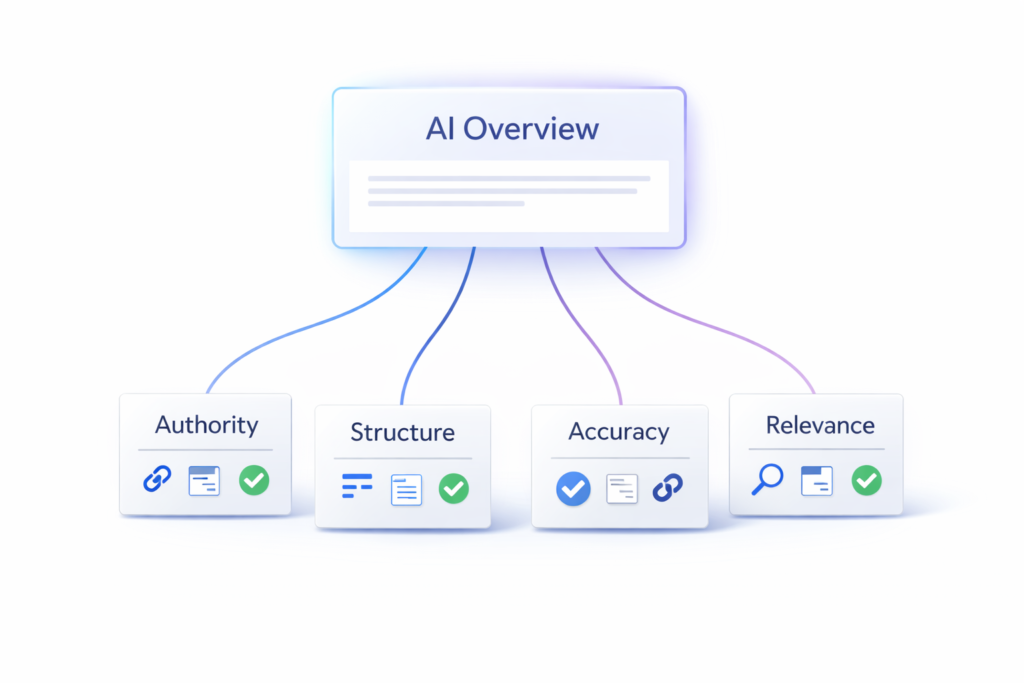
Google’s AI tends to select sources that are highly authoritative, well-organised and accurate when summarising news. Content that includes direct answers to specific questions and is clear in its language is more likely to be selected for the summary.
Google does not publish a definitive rulebook for AI Overviews, but there are patterns that the savvy recognise early on.
AI systems tend to favour content that behaves like a clear, reliable explainer.
This is where concepts like LLM SEO and generative engine optimisation become important. These approaches focus on how content is structured, interpreted, and reused by AI systems.
In most cases, selected sources share several traits:
- clear structure
- strong topical coverage
- direct explanations
- consistent context
Put simply, content that is easy to understand is easier to cite.
In practice, many Singaporean businesses are still early in their adoption of AI search, creating a short-term opportunity for those who move quickly.
What Influences Google AI Overview Rankings
These signals are not applied in isolation.
Google’s AI builds on existing ranking systems — evaluating relevance, quality, and authority — but applies them in ways that support summarisation and citation.
Understanding how these signals work together explains why certain pages are consistently selected.
Topical Authority
Websites that publish consistently around a subject tend to be cited more often.
A site that covers AI search from multiple angles — tools, frameworks, structure — sends a stronger signal than a page that mentions it once.
This is why building clusters that include resources like best LLM SEO tools strengthens overall visibility.
Content Structure for AI Search
AI models process structured content more effectively than scattered ideas.
Pages that use:
- clear headings
- logical sections
- concise explanations
are easier to analyse and summarise.
This aligns with how AI systems evaluate content for extraction, not just ranking.
Factual Accuracy and Credibility
AI systems prioritise reliable information.
Clear explanations, consistent definitions, and factual accuracy matter more than clever phrasing.
Ultimately, if the meaning is ambiguous, the content is less likely to be used.
Domain Reputation
Authority still plays a role.
Websites with strong backlinks, brand mentions, and industry presence tend to be cited more frequently.
However, reputation alone is not enough. You must have content structured for AI interpretation.
How to Optimise Content for Google AI Overviews
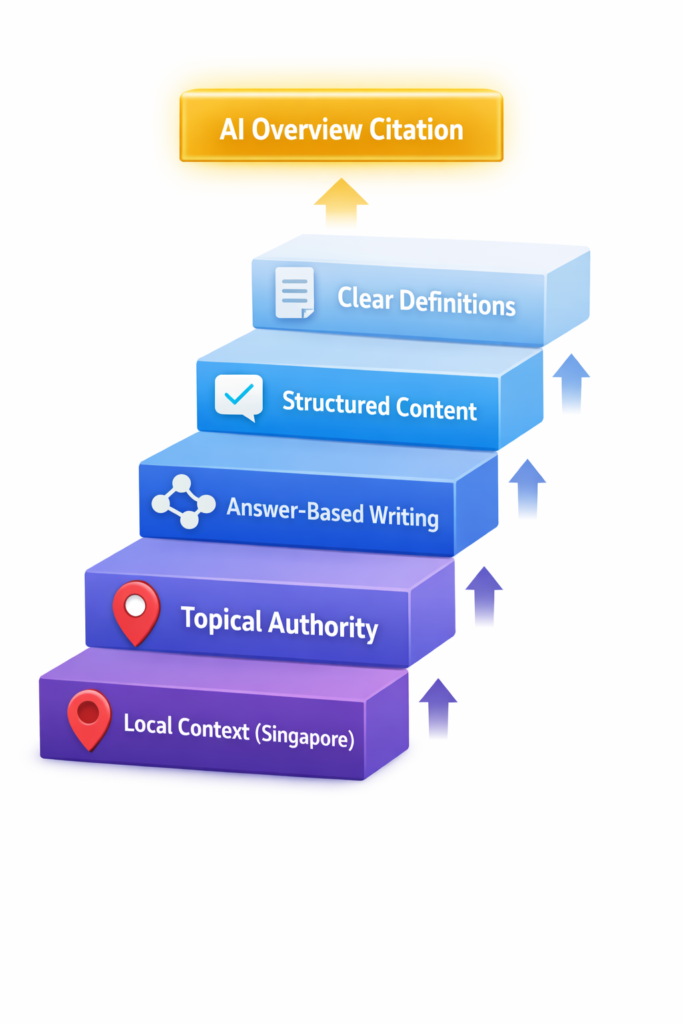
Understanding how AI Overviews work is only the starting point.
Now that we have our questions and topics, we have to organise our content so that it can be easily read and summarised by a computer. Why? Well, the fact is that AI loves to deal with the simplest, most direct and most logical stuff.
In practice, a few core principles make the biggest difference.
Write Clear Definitions
AI summaries often begin with definition-style explanations. Clear opening statements increase extractability because large language models tend to prioritise the first concise explanation they encounter when forming an answer. Defining key concepts early reduces ambiguity and allows AI systems to confidently reuse your content as a reference point in generated responses.
Structure Content Logically
Each section should follow naturally from the previous one. If a reader needs to pause and interpret, AI will struggle too, as models rely on predictable structure and clear hierarchy to understand relationships between ideas. Well-organised headings and a logical flow help AI systems segment content into meaningful “chunks” that can be independently extracted and cited.
Answer Specific Questions
AI Overviews often respond to question-based queries. Direct answers improve the likelihood of being extracted because AI systems match content to user intent at the prompt level, not just keywords. Pages that clearly address specific questions using natural, conversational phrasing are more likely to be selected as source material for generated answers.
Build Topic Clusters
Authority rarely comes from a single page.
Instead, develop connected topics around a central theme that includes relevant topics that genuinely interest your potential clients.
You can already see this shift reflected in discussions around how effective AI SEO is, where visibility increasingly depends on interpretation rather than position.
Add Singapore Context
For businesses operating in Singapore, localisation is key. Content that is relevant to the local market and user behaviour in Singapore, as well as Singapore-based scenarios and search intent, is more likely to be identified and perceived as valuable by search engines. This aligns with how search engines interpret location-based intent. For instance, Google stated that search results for local queries will be based on a combination of relevance, distance, and prominence, indicating that the user’s location and the geographical context of their search query significantly influence the results.
How to Get Cited in Google AI Overviews
At this point, the goal becomes simple.
Content needs to be presented in a way that AI can extract and reuse directly — because AI systems identify and summarise the most relevant parts of a page rather than processing it as a whole.
The clearest way to do that is to make the answer immediately visible.
AI-Ready Summary (Quick Answer)
For a piece of content to be eligible to be cited in a Google AI Overview, it must be high quality, well presented, and factually accurate in a way that enables AI to efficiently and effectively extract and summarise it.
Pages with greater topical authority, better organisation, and briefer explanations of their content, using more authoritative sources, tend to perform better in Google search results.
Key Factors That Increase AI Citation Probability
Pages are more likely to be cited when they:
- Explain topics directly: In addition, AI systems can be designed to prioritise content that explains topics directly, in an answer-first fashion, making it easier to extract and reuse information in the responses they generate.
- Ensure content is properly structured: All algorithms that power summary tools and search engines rely heavily on spotting trends, patterns and relationships within the structure and arrangement of your words. Good structures include headings, sound subsection titles, and bullet points and/or other lists of key points.
- Answer specific queries: Pages that closely match user intent and directly address common questions are more likely to be retrieved and cited by AI systems.
- Maintain topicality: A high concentration of relevant terms with sufficient semantic depth indicates strong topicality, thereby boosting the source’s reliability.
- Accuracy and verifiability are critical: AI tends to quote reliable, verifiable, auditible and trustworthy sources. AI systems audit websites and sources and examine which sources are trustworthy to determine whether the cited information is correct.
What Makes Content Easy for AI to Extract
All AI systems want to work with predictable content. What does predictable mean? A simple definition is that predictable content is easy to read. In particular, for any given chunk of text, it should be possible to guess what the topic sentence is and to infer roughly what the author meant. Predictable text is short, focused on a few main points, has easily identifiable topic sentences and is as unambiguous as possible. The benefits of training an AI to structure your writing this way are that the system can then easily select and reliably use individual sections or paragraphs of text.
The more direct, clear, and structured the output is, the less work the algorithm has to do to extract what it needs from the training data, infer what is relevant, and insert it where it is likely to be most helpful to the user.
Common Mistakes That Reduce AI Visibility
Some content performs well in traditional SEO but struggles in AI search.
Common issues include:
- overly long paragraphs
- vague explanations
- inconsistent structure
- filler-heavy writing
These reduce clarity, and clarity determines extractability.
AI Search and the Future of SEO
Search is shifting towards answer-first interfaces. Instead of simply ranking pages, search engines increasingly synthesise responses from multiple sources into a single, generated answer.
This shift is not small. Studies suggest that AI Overviews now appear in roughly 15–20% of searches, depending on query type, and their presence is already reshaping user behaviour. When AI summaries appear, click-through rates tend to decline, with research showing reductions of over 30% in some cases.
All of these point to a bigger change in the DNA of search. All in all, visibility is no longer defined purely by rankings, but by whether a source is selected and included in the generated response.
For Singapore businesses, the implication is clear — SEO is no longer just about ranking. It is about becoming a reference point.
Final Thoughts and How to Align Your Strategy with The Leading Solution
Google AI Overviews mark a shift from search results to generated answers. And while fundamentals have not changed, getting cited by Google has now become the biggest opportunity for businesses looking to gain an edge.
Those who adapt early will not just rank. They will be referenced. For those navigating this shift, the next step often starts with aligning content strategy to how AI systems actually select and surface information.
And for businesses looking to align their strategy with the evolving AI search landscape, the next step often begins with a clearer conversation about direction and execution here.
About The Director
Notable Achievements


Struggling to Attract More Traffic?
Let us help! We provide various digital marketing services that can easily rank your website on the first page of Google such as:
Allow your website to be seen by more users by scheduling an appointment with us today!