
It’s been about a year or two since we were worrying about whether AI would be the end of search as we know it today. Today, late 2026, we no longer even ask this question. Search hasn’t disappeared. It has multiplied.
While most searches are still conducted using Google (and occasionally ChatGPT, Perplexity, Gemini, etc. for specific use cases), they are now also used to ask questions on your phone, take photos of products you are considering to purchase online, and for software to research, compare and even purchase for you — all without ever seeing a traditional search results page.
In practical terms, SEO has increased in scope. Classic ranking for blue links is still relevant, being mentioned in generated answers is increasingly relevant, and preparing a website so that it can be read by specialised search agents is becoming relevant. This is where advanced AI SEO services can help maintain strong visibility across these new surfaces.
Here’s what that looks like heading into 2027.
From SEO to GEO (and why the labels are starting to blur)
Generative Engine Optimisation (GEO) (also known as Answer Engine Optimisation) was the new black of Search Engine Optimisation in 2025 and 2026. The purpose of GEO is to write content in a way that large language models reference in their output.
By mid-2026, Google has assessed the practice of Answer Engine Optimisation and provided a practical guide to the topic. Essentially, GEO is an extension of current Search Engine Optimisation practices. Therefore, setting up a solid technical foundation, clear authority signals, original expertise and well-structured content will remain the core of GEO. Most of the current ‘AI-only’ SEO practices and techniques (e.g. various schema hacks and treating llms.txt files as magical files) are already being refuted by experienced practitioners. In addition, quality algorithms will become stricter and continue to attempt to target unverified or low-value online content.
Note that today, top-performing SEO teams treat SEO and GEO as a single practice to achieve the best results — this is different from focusing solely on AI SEO strategies. They’re interested in rankings and traffic as before, but also in how often a brand or piece of content is cited in AI-generated answers. The share of citations is becoming an important KPI to track alongside other traditional organic traffic metrics.
AI Answers, Zero-Click, and the Rise of Agents
Zero-click searches now sit in the mid-to-high 60% range in mature markets for many informational queries. AI Overviews and AI Mode reach billions of users every month. A meaningful share of product research and comparison already happens inside chat interfaces before anyone lands on a retailer site.
Looking toward 2027, the next layer is agentic search. AI agents that research, shortlist, and even execute purchases on a user’s behalf are moving from experiment to early product. Several forecasts suggest a substantial portion of digital interactions will be mediated by these agents within the next couple of years.
Voice continues to play a role inside these experiences. MarketsandMarkets still projects strong growth for speech and voice recognition technologies, and voice search optimisation remains useful as conversational interfaces expand.
This changes the optimisation target slightly. Content needs to be legible to machines as well as humans — clear entities, accurate structured data, up-to-date facts, and strong signals of real expertise and experience (especially the first “E” in E-E-A-T). Brands that treat their content as reliable source material for both people and agents will have an advantage.
Traditional transactional and local search remains more click-driven. Informational and research-heavy queries are the ones shifting fastest.
Personalisation, Privacy and the Technical Baseline

Personalisation using zero-party data (i.e. data volunteered by users) is still expected by users. 76% of consumers expect to receive personalised experiences from companies, according to the McKinsey report. Users will increasingly receive personalised search results from Search powered by AI Mode, or “Relevance Engineering” as it’s sometimes called.
Generative AI is gaining clarity around the PDPA in Singapore, and has recently received additional guidance in the form of July 2026 advisory guidelines from the PDPC on the use of generative AI for personal data. These guidelines outline key considerations for the training data, required consent, notification to the regulator, and the distribution of responsibilities throughout the development lifecycle and subsequent deployment of the generative AI system.
So basically, none of the technical fundamentals has changed. In fact, they’ve become even more important. For most sites, enabling crawling for basic performance metrics will be a first step toward also supporting the determination of AI Citation Likelihood.
What is the Future of SEO in Singapore?
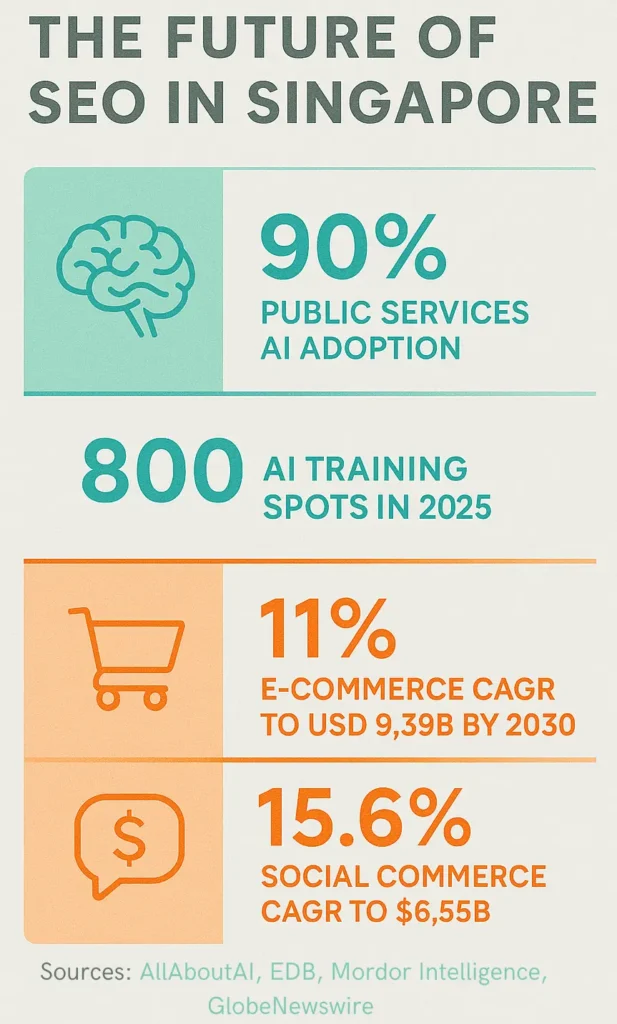
Singapore’s vibrant digital economy positions it as a harbinger for SEO’s global trajectory, amplified by the Smart Nation initiative. With Google’s over 94% market dominance as of July 2025, local SEO will increasingly intersect with AI-driven personalisation and mobile-first designs. This section breaks down key facets, drawing on recent data to illustrate the path ahead.
AI Adoption Driving SEO Innovation
As the broader AI market is expected to grow to $4.64 billion by 2030, public sector adoption of AI solutions remains high. Thus, SEO solutions are being built to support organisations in managing both traditional search engine rankings and AI citation likelihood, often with the help of AI tools.
E-Commerce and Mobile-First Growth
E-Commerce growth and Social Commerce growth: In terms of actual numbers, e-commerce in Singapore will grow at an 11% CAGR and reach USD 9.39 billion by 2030. Social Commerce, on the other hand, will grow at a 15.6% CAGR and reach USD 6.55 billion by 2030. Design-wise, for now, mobile-first design is still key, and hence, strong product data and good visual optimisation for both classic search results and AI-driven recommendations are still needed.
Compliant SEO and Ethical Challenges
As we previously mentioned, the use of personal data in AI systems is also a matter of Privacy and compliance. In this case, Singapore’s Privacy law (PDPA) as well as the GenAI advisory guidelines by the government would apply. Businesses that treat compliant SEO as a competitive advantage (instead of just managing risks) will also be better off.
Businesses that treat SEO as “visibility wherever people (and agents) look for answers” instead of “rankings on Google” will be better prepared for 2027 and onwards.
FAQ: Common Questions on the Future of SEO
What is the global future of SEO in 2027 and beyond?
In addition to rankings on search engine results pages (SERPs) and increasing visibility of a website through search, there are also other considerations, such as being cited in GEO (AI-generated answers) and having content that is prepared for and can be read by agents, i.e. is useful, authoritative and present on various surfaces.
Will AI fully replace traditional SEO?
No. Search is changing, not in a way that reduces the value of SEO expertise, but rather in ways that will be added to by GEO (and potentially by others) to become SEO + GEO, a new practice focused on delivering useful information to users of the web.
Should we still care about rankings if zero-click searches are rising?
Yes. Rankings and classic organic traffic remain important, especially for transactional and local queries. Measuring your share of citations in AI-generated answers (GEO) and your brand mentions within them is fast becoming as important as traditional rankings.
Conclusion: Embracing the Future of SEO
Future of SEO: The Search for Answers on Multiple Surfaces. As Search becomes more pervasive on multiple surfaces, sometimes through software that is searching for the user, future SEO must be based on a broader surface area.
At its core, SEO is still about helping people (and, increasingly, software agents) find the best answer to a question. That information has to be clear and trustworthy, too.
The future of SEO will consist of businesses that continue to develop strong technical and content foundations, treat SEO and GEO as one practice, remain compliant and measure influence beyond last-click traffic.
If you’d like help adapting your SEO strategy for 2027, feel free to get in touch with The Leading Solution.
About The Director
Notable Achievements

Struggling to Attract More Traffic?
Let us help! We provide various digital marketing services that can easily rank your website on the first page of Google such as:
Allow your website to be seen by more users by scheduling an appointment with us today!