
Self-sufficiency is key, especially when you’re just starting your business with a limited budget and looking up “SEO training Singapore” as your first accreditation. In most cases, people looking up that keyword want to know what the service involves and whether it’s worth the time and investment. And while the term sounds straightforward at first, it often means more than attending a standard course.
Throughout the world, SEO training covers everything from learning how search engines rank content to interpreting search intent and building visibility in a deliberate, measurable way. In Singapore, the conversation goes one step further – SEO is not a hobby skill, but a structured professional development supported by government-funded programs like WSQ and SkillsFuture.
People often jump straight into comparing the best SEO courses in Singapore. But without knowing what good training should include, it’s difficult to evaluate them properly — particularly in the Singapore context.
What Is SEO Training?
SEO training helps you learn how search engines work and how to boost your brand’s online presence. A typical training course teaches the following skills:
- Understand search intent
- Conduct meaningful keyword research
- Optimise on-page elements
- Improve technical site health
- Measure performance using real data
That’s the universal layer.
What Makes SEO Training in Singapore Different?
While SEO principles remain global, Singapore has its own intricacies when it comes to the delivery model.
In Singapore, SEO training sits within the Workforce Skills Qualifications (WSQ) framework as part of its national adult learning system. Learners who enrol in such training don’t just attend lectures. They complete assessments. They demonstrate practical ability after which they receive recognised statements of attainment.
On top of that, many SEO programmes qualify under SkillsFuture funding schemes. That changes how people view training. It becomes professional upskilling rather than casual learning. Employers sponsor it. Mid-career professionals take it seriously. Business owners treat it as capability development.
Why Learn SEO in Singapore?
As roughly 88% of Singaporeans use social media, Singapore’s digital landscape underpins much of its commercial activity.
Whether you operate an SME, a service-based business or an e-commerce store, search remains one of the most stable acquisition channels available. Paid ads drive traffic quickly — but costs continue to rise. Organic search builds resilience, especially in a market where paid competition continues to intensify. It’s one reason many businesses eventually explore structured SEO services in Singapore alongside internal capability building.
Learning SEO gives you control.
It allows marketers to:
- Reduce dependency on paid media
- Understand how search demand evolves
- Build content assets that compound over time
For business owners, it sharpens judgment. You begin to ask better questions and evaluate agencies more critically. You understand what realistic growth looks like.
In a competitive, digitally mature market like Singapore, that knowledge carries weight.
What Does SEO Training Typically Cover?
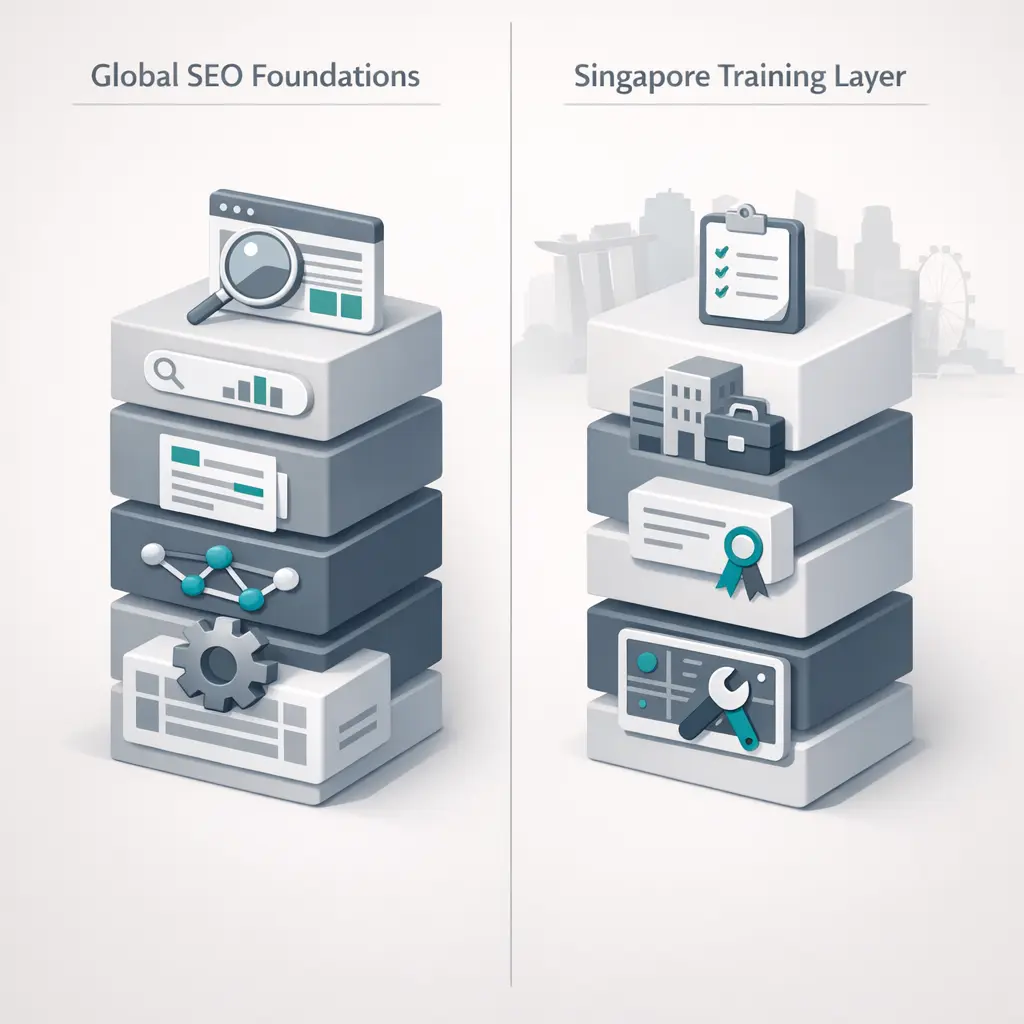
Evaluating SEO training options requires knowing what a strong programme should include. Let’s separate this into two layers:
- What strong SEO training covers anywhere in the world
- What Singapore-based programmes tend to emphasise
Standard SEO Training Topics
Any credible SEO training programme — online or classroom-based — should cover these core areas.
1. Search Engine Fundamentals: From the fundamentals of how search engines crawl, index and rank content.
2. Keyword Research & Search Intent: This goes beyond finding high-volume terms. Strong SEO training shows you how to use the best AI SEO apps and map the info to your content strategy.
3. On-Page Optimisation: Titles. Meta descriptions. Heading hierarchy. Internal linking. Content structure. Strong training shows you how to approach SEO copywriting and align your content with search intent.
4. Off-Page SEO: Backlinks and authority signals still matter. Still, training helps you build long-lasting credibility instead of using temporary shortcuts.
5. Technical SEO: Crawlability. Site architecture. Page speed. Mobile responsiveness. Core Web Vitals. You don’t need to become a developer. But you must understand how structure influences visibility.
6. Analytics & Reporting: Search Console. Analytics platforms. Performance tracking.
If you cannot measure impact, you cannot improve results. Modern programmes increasingly introduce automation and AI SEO strategies to help interpret data more efficiently.
What Singapore-Based SEO Training Often Emphasises
Knowing the basics will help form the global baseline, but you’ll still need to know the local intricacies. Here’s where local nuance appears:
1. Competency-Based Assessment (WSQ Structure)
Under the WSQ framework, learners complete structured assignments. Assessors evaluate outcomes against defined standards. Training becomes measurable and outcome-driven.
This shifts the mindset toward demonstrating capability instead of simply absorbing information.
2. Workplace Application
Singapore programmes often frame SEO as a practical business skill that shapes the way you deliver results:
- For marketing executives
- For SME owners
- For professionals switching careers
The question becomes:
“How will I apply this next week?”
3. Subsidised Upskilling
With SkillsFuture funding available for many programmes, learners treat SEO training as structured professional development. It becomes part of career progression planning.
4. Tool-Centric Learning
Local courses frequently introduce real tools early:
- Search Console walkthroughs
- Keyword research exercises
- Live site audits
Common Formats for Learning SEO
In Singapore, there are different types of SEO training. And while all formats deliver similar outcomes, each has a different structure and learning style.
| Learning Format | What It Involves | Best Suited For |
|---|---|---|
| WSQ Classroom Training | Structured, instructor-led sessions aligned with competency standards under the WSQ framework. Includes assessments and recognised certification outcomes. | People who are looking for detailed instructions and recognised credentials. |
| Workshops & Bootcamps | Workshops are usually shorter but more intensive, focusing on practical implementation with hands-on examples and exercises. | Business owners or marketers with limited time looking to learn the fundamentals.. |
| Online Courses & Certifications | Modular and flexible programmes that allow participants to learn global SEO at their own pace. | Learners seeking foundational knowledge or flexible schedules. |
| Self-Directed Learning | Blogs, documentation, case studies and experimentation on live projects. No formal structure. | Disciplined individuals who learn best through practice and independent research. |
How to Plan Your SEO Learning Path
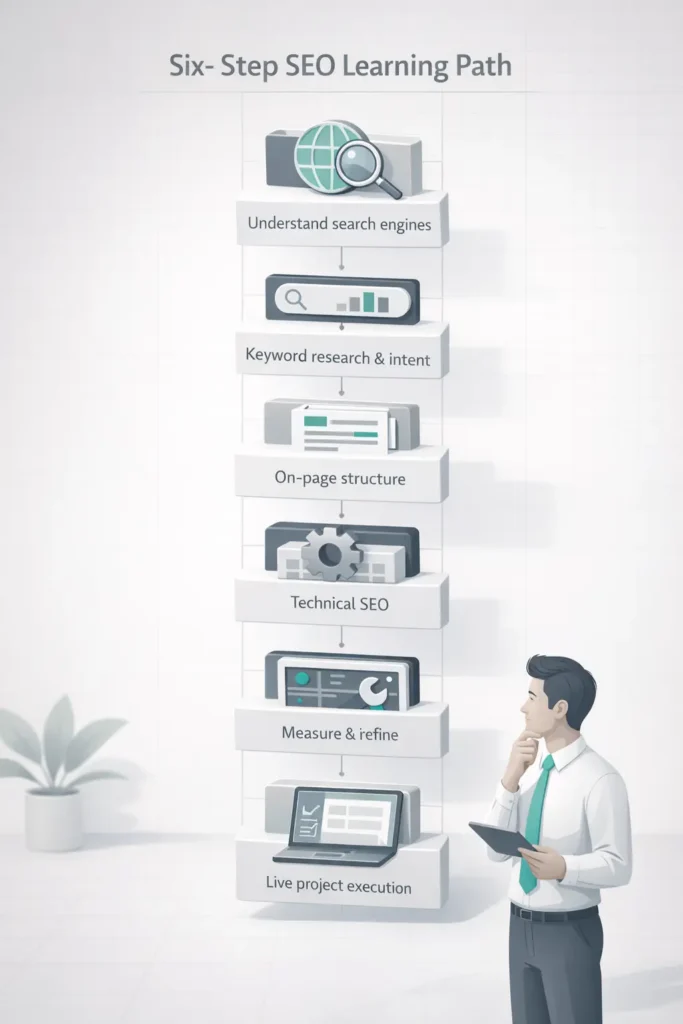
Before you start your learning journey, it helps understand that SEO rewards iteration, but getting the right framework requires proper training. Once you approach things more seriously, you will learn how to master the art through precise execution:
- Understand how search works, specifically crawling, indexing and ranking basics.
- Master keyword research and intent mapping using AI to know what clients are actually searching for before creating content
- Optimise on-page structure properly to make your website exude clarity.
- Work on the technical foundations so Google can access and rank your site.
- Measure and refine your content to keep your website relevant.
- Build real projects and don’t be afraid to experiment.
What Outcomes Should You Expect From Good SEO Training?
Effective SEO training should enable you to:
- Evaluate keyword opportunities realistically
- Optimise content with confidence
- Identify technical weaknesses
- Interpret search data accurately
- Develop sustainable search strategies
It should not promise overnight rankings, and it should not guarantee instant traffic. Instead, it should equip you with judgment. And judgment compounds.
Frequently Asked Questions About SEO Training in Singapore
Is SEO training recognised in Singapore?
Yes, you can enrol in a WSQ-approved programme and qualify for SkillsFuture funding.
Can I learn SEO without attending a formal course?
Yes, you can start with self-study, but enrolling in professional training will accelerate your progress and reduce the risk of costly mistakes.
How long does SEO training take?
Foundational understanding can develop within weeks. Mastery takes ongoing practice. SEO evolves constantly.
Is SEO training worth it for business owners?
If your success is heavily reliant on your online presence, then you’ll greatly benefit from understanding the fundamentals of SEO, even if you outsource execution later on.
Final Thoughts
SEO training in Singapore sits at the intersection of global digital principles and a structured national upskilling framework. The principles remain universal, but the delivery model carries local nuance.
If you approach SEO training with clarity — focusing on fundamentals, application and measurement — you build a skill that strengthens over time.
Search does not reward shortcuts. It rewards understanding. And that is precisely what good SEO training should give you. If you prefer combining internal capability with external execution, working with a specialist team often accelerates clarity and results. You can speak with The Leading Solution to explore what that might look like in practice.
About The Director
Notable Achievements


Struggling to Attract More Traffic?
Let us help! We provide various digital marketing services that can easily rank your website on the first page of Google such as:
Allow your website to be seen by more users by scheduling an appointment with us today!