

“LLM SEO tool” was a non-existent term until a couple of years ago. Until recently, SEO focused almost entirely on Google rankings. But with platforms like ChatGPT, Gemini, and Perplexity, search has rapidly evolved into a more direct, intent-based experience.
According to research from McKinsey’s report on AI‑powered search adoption, around half of consumers already use AI-powered search tools, and the channel could influence $750 billion in revenue by 2028.
We have entered an era where Digital Reputation cannot be defined solely by rankings and reviews. For a Singapore business, the competition in the digital sphere is already very intense and AI is rapidly accelerating in many sectors. With the rise of Large Language Models (LLMs), more businesses want their content to be understood, summarised, and referenced.
That is where the right LLM SEO tool becomes an essential part of AI SEO services.
In this guide, we explore the best LLM SEO tools, how they work, and how businesses can monitor their visibility in AI search engines.
What Are LLM SEO Tools?
LLM SEO tools are software solutions that help marketers monitor and improve how their content is represented in the AI-based answers provided by chatbots such as ChatGPT or the Google AI Overviews.
Traditional SEO tools measure metrics such as:
- rankings
- backlinks
- organic traffic
However, AI search introduces a new objective: being cited inside generated answers.
The term for this approach is generative engine optimisation (GEO). Writing for AI in such a way that a content layer can be interpreted and used by AI engines to generate responses.
In simple terms:
- Traditional SEO tries to rank a webpage.
- LLM SEO tries to become the source behind an AI answer.
A good LLM SEO analysis tool therefore measures signals such as:
- AI citations
- brand mentions in responses
- prompt-level visibility
- competitor presence in AI answers
For marketers looking for a broader list of platforms that use artificial intelligence for keyword research, content optimisation and automation, see our guide to AI SEO apps.
Why LLM SEO Tools Are Becoming Essential
Artificial intelligence has rapidly entered everyday digital behaviour through generative tools now integrated into many online services. Recently published data indicate that more than a third of people in OECD countries used generative AI in 2025, driven in part by the widespread adoption of ChatGPT and the growing use of AI-assisted search engines. The latter proves that the way we search online is also changing.
Traditional search engine results used to list relevant web pages, but are now often replaced by direct answers and a summary of what multiple sources say. This behavioural shift aligns with research suggesting that 20–50% of traditional search traffic could be affected by AI search interfaces, as generative summaries answer queries directly.
This creates a new visibility challenge, requiring businesses to ensure their content is included in the source material AI systems use to generate answers.
A reliable LLM SEO tracking tool helps organisations monitor:
- which prompts mention their brand
- how frequently competitors appear
- how AI models interpret their content
Without this data, companies effectively operate blind in the AI search ecosystem.
6 Best LLM SEO Tools in 2026
ChatGPT, Claude, and Gemini are already go-to software for daily use. However, each LLM SEO tool serves a different purpose, such as AI visibility tracking, content optimisation or authority building.
Below is a quick comparison of the tools in the emerging LLM SEO space that we’ve been discussing.
| LLM SEO Tool | Category | Key Function | Best For |
|---|---|---|---|
| Otterly.ai | AI visibility tracking | Tracks brand citations in AI answers | Agencies monitoring AI visibility |
| Profound | Enterprise AI analytics | Measures AI presence across LLM platforms | Large organisations |
| Peec AI | Competitive monitoring | Tracks competitor mentions in AI responses | SaaS and technology companies |
| Surfer SEO | Content optimisation | Improves semantic structure and topical coverage | Content teams |
| Clearscope | Authority optimisation | Identifies missing entities and topic gaps | Long-form content |
| Ahrefs | SEO foundation | Backlinks, keywords and authority signals | SEO professionals |
These tools generally fall into three categories:
- AI visibility tracking
- Content optimisation
- Traditional SEO authority platforms
Let’s examine them in more detail.
Otterly.ai – AI Citation Tracking
Otterly focuses on monitoring brand visibility in AI-generated answers.
As an LLM SEO tracking tool, it analyses:
- AI citation frequency
- brand mentions across prompts
- sentiment within responses
If you’re running an AI SEO campaign, this software helps measure whether optimisation efforts influence AI answers. For example, agencies can run a prompt such as “best SEO agency Singapore” and track whether their brand appears in ChatGPT responses.
Profound – Enterprise AI Search Analytics
Profound provides deeper analytics for organisations monitoring AI search visibility at scale.
The platform analyses cross-model brand mentions and response-sentiment patterns, and examines how answers are structured across prompts.
For large enterprises, this LLM SEO analysis tool offers a high-level overview of how generative search engines interpret their brand.
Peec AI – Competitive AI Monitoring
Peec AI focuses on benchmarking visibility against competitors.
Rather than analysing only your brand, it evaluates how competing brands appear in AI-generated responses.
This category of LLM SEO tracking tools helps marketers identify:
- dominant brands in AI answers
- citation gaps
- competitive opportunities
Surfer SEO – AI-Friendly Content Structure
Some LLM SEO tools do not track visibility directly. Instead, they help improve the structure of the content itself.
Surfer SEO focuses on:
- semantic coverage
- entity relationships
- topical authority
These signals help AI models interpret content more clearly when generating answers.
Clearscope – Building Topical Authority
Clearscope helps content teams identify missing semantic entities within articles.
The platform strengthens topical authority by ensuring articles cover the relevant themes and concepts associated with a topic.
As an LLM SEO analysis tool, it helps ensure content includes the contextual signals AI systems prefer.
Ahrefs – SEO Foundations Still Matter
Even in the age of AI search, traditional SEO remains critical.
Research analysing LLM discovery shows that websites with stronger authority signals (including backlinks) are more likely to appear in AI responses.
Platforms such as Ahrefs, therefore, remain essential.
They provide the SEO foundation that supports visibility in both traditional search engines and AI discovery platforms.
How to Choose the Right LLM SEO Tool
Selecting the right LLM SEO tool depends largely on your objectives.
While many SEO teams are still experimenting with the best ways to monitor AI visibility in search, the tools available are relatively new, and the industry is changing quickly.
A search engine’s algorithm is dynamic and can change at any moment, which means that any current best practices for monitoring and understanding an AI’s crawler activity and its current understanding of content may no longer be valid shortly after they are adopted.
Monitor AI Visibility
If your priority is measuring whether your brand appears in AI responses, a dedicated LLM SEO tracking tool is the best option.
These tools analyse prompts across multiple AI engines to measure citation frequency.
Improve Content Structure
If your focus is on content quality, tools that strengthen semantic coverage and entity relationships can help AI systems interpret your content more accurately.
Build Authority Signals
AI models still prioritise credible sources.
Traditional SEO tools remain necessary for building authority signals that influence both search engines and AI systems.
Most organisations therefore rely on a combination of tools rather than a single platform.
LLM SEO Tools vs Traditional SEO Tools
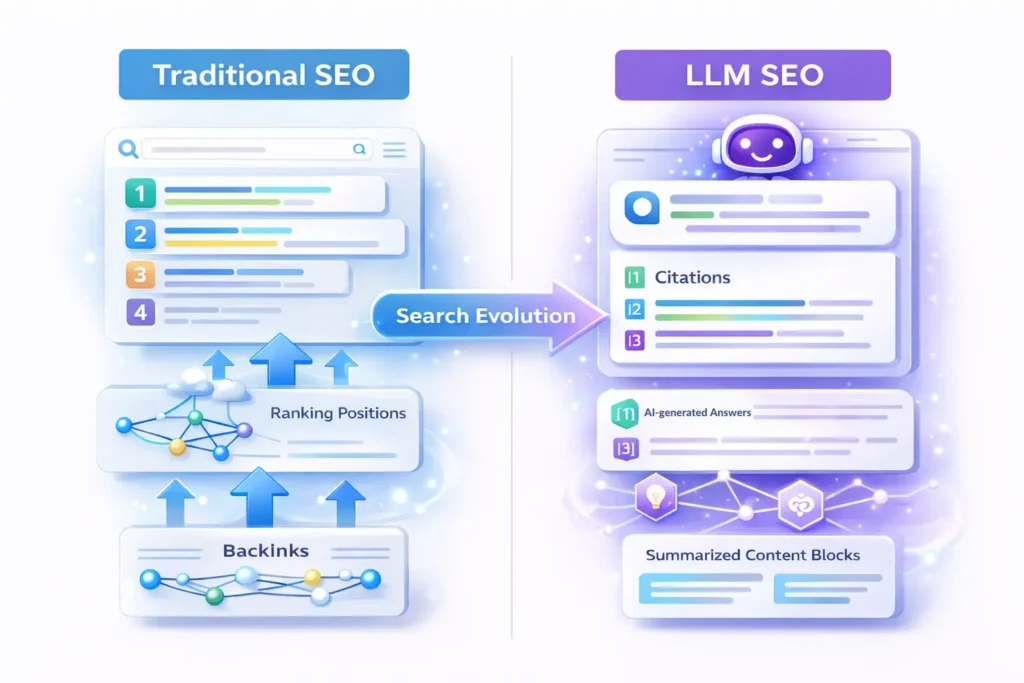
AI optimisation introduces a new layer of digital marketing.
Traditional SEO focuses on rankings and traffic, while LLM SEO tools focus on AI citation visibility.
| Feature | LLM SEO Tools | Traditional SEO Tools |
|---|---|---|
| Primary Goal | Monitor AI citations | Improve search rankings |
| Key Metrics | AI mentions, prompt visibility | Rankings, backlinks, traffic |
| Discovery Model | AI-generated answers | Search results pages |
| Optimisation Focus | Machine-readable content | Keywords and link authority |
| Example Tools | Otterly, Profound, Peec | Ahrefs, SEMrush |
Both approaches remain important.
Traditional SEO builds the authority signals that AI systems rely on, while LLM SEO tools measure visibility in AI responses.
Together, they form the foundation of modern AI search optimisation.
The 5 Signals LLMs Use to Choose Sources

Mainstream large language models tend to draw information from sources based on their perceived authority, readability, and format. Having expert information, being clear, and using credible sources can increase the likelihood that a source will be included in an AI-generated query.
When we look at studies on generative search optimisation, we can see that AI tends to favour sources with clear headlines, a brief summary, and adequate authority signals.
AI systems do not randomly select sources.
Most large language models rely on several signals when choosing which websites to reference.
These include:
- Topical authority – comprehensive coverage of a subject
- Semantic clarity – structured explanations AI models can summarise
- Credible citations – authoritative sources and backlinks
- Content structure – headings, lists and tables that improve machine readability
- External references – mentions across third-party websites
In other words, the websites most likely to be cited are those that combine strong SEO foundations with clear, structured content.
This is why modern optimisation increasingly combines traditional SEO with AI-focused content strategies.
Conclusion
AI search has dramatically changed the way we find information online. From scanning lists of links, we now rely on AI to understand our intent and generate an answer based on that. But while this process has made it easier for regular users to get quick, accurate results, businesses must have their content cited by AI systems to gain visibility.
The right LLM SEO tools provide valuable insight into this emerging ecosystem. They reveal how AI models interpret your brand, which prompts trigger citations, and where competitors dominate AI responses. However, tools alone are not enough. Visibility in AI search still depends on authoritative content, strong topical coverage and clear structure. At The Leading Solution, you can speak with a specialist through an AI SEO consultation to discuss the best strategy for your business.
Frequently Asked Questions About LLM SEO Tools
What is an LLM SEO tool?
An LLM SEO tool helps marketers monitor whether their content appears inside AI-generated answers from systems such as ChatGPT or Perplexity.
Why are LLM SEO tools important?
They allow businesses to track visibility in AI responses, which are becoming an increasingly important discovery channel.
Do traditional SEO tools still matter?
Yes. AI systems still rely heavily on signals such as backlinks, authority and structured content.
What is generative engine optimisation?
Generative engine optimisation (GEO) is the practice of structuring content so AI systems can interpret and cite it in generated answers.
Do Singapore businesses need LLM SEO tools?
Yes, they do. With AI-generated answers now significantly influencing how users discover services online, companies in Singapore need to be aware of how their brands are referenced in these systems’ answers. Using the right LLM SEO tools allows them to monitor all relevant citations, check on the visibility of their competitors and optimise their content for these new search platforms.
About The Director
Notable Achievements


Struggling to Attract More Traffic?
Let us help! We provide various digital marketing services that can easily rank your website on the first page of Google such as:
Allow your website to be seen by more users by scheduling an appointment with us today!