
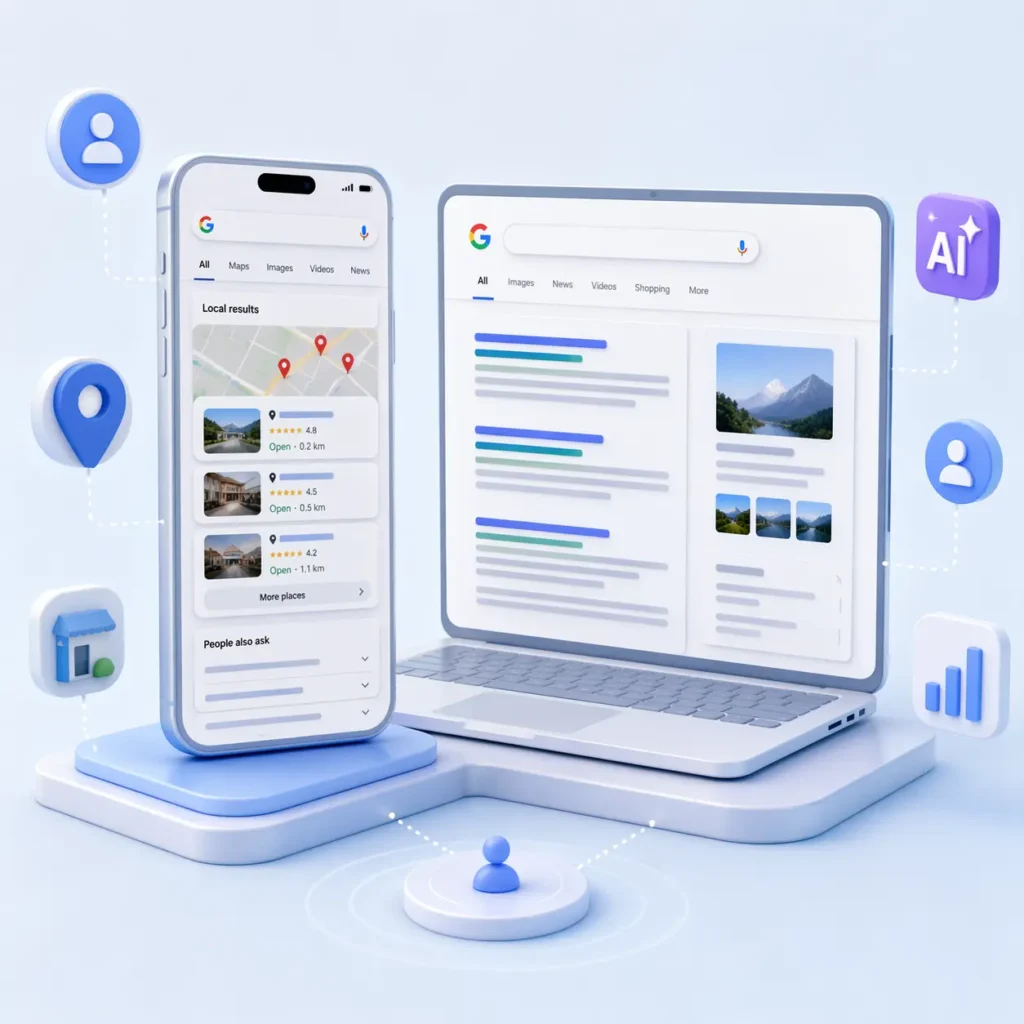
Online search has changed. Google is now delivering personalised results not only across individual desktop users but also across multiple devices. Historically, results were ranked mainly by relevance and authority. Today, they are shaped by context such as location, behaviour, and intent.
Most people think of the #1 position looking the same across the board, pinned to the top of the search results, identical to what your SEO tools report. But the top spot doesn’t always look the same across desktop and mobile searches. And it may not even look the same to your SEO tools.
While visibility at the top of the search results certainly matters, relevance is also tied to the context of your search and the device you’re using, and this is exactly why businesses are turning to AI SEO services.
Why Are Google Search Results Different?
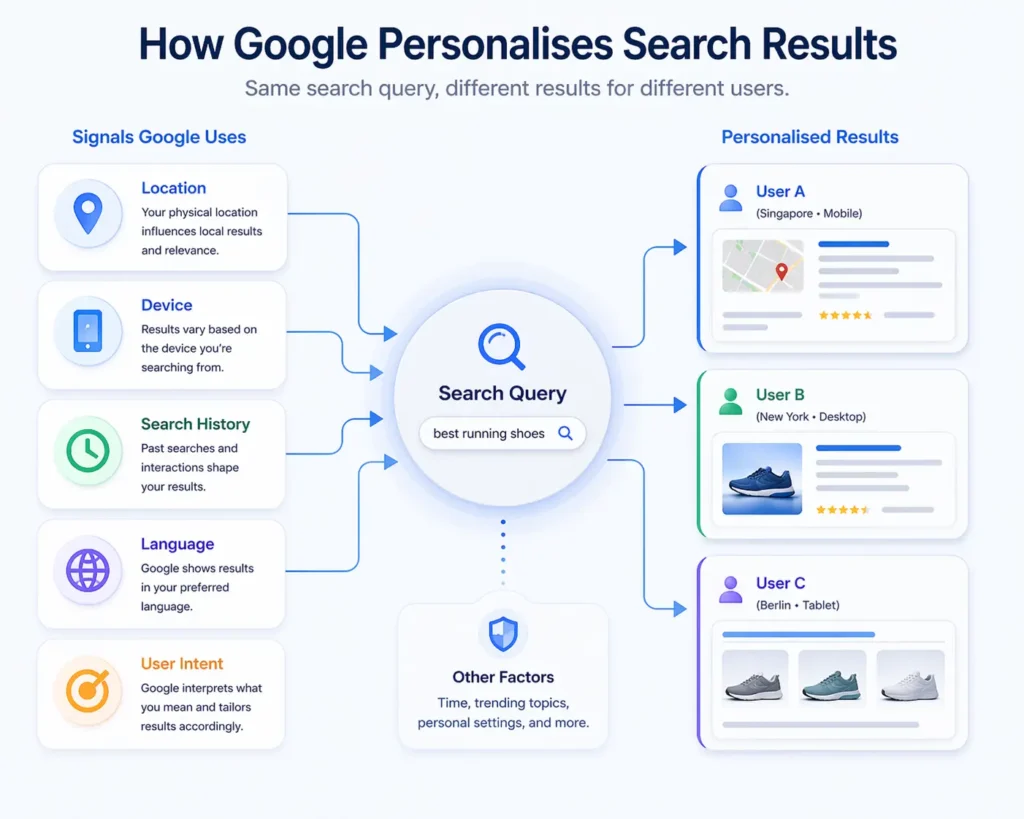
People generally think of Google as providing a static list of links ordered by relevance. But in reality, Google acts much more like a real-time recommendation system. This means that results are constantly updated to better match a user’s needs. That’s why, according to LLM SEO frameworks for understanding content retrieval and ranking, you can get different results for the same search query on different devices.
Google provides personalised results for each user based on device type, location, and search context. Depending on your settings, search history may also play a role. According to Google, search results may vary based on timing, search context, and personalisation based on user activity.
Are Google Search Results Different for Everyone?
Results from internet searches for the same query can differ dramatically. This reality, which impacts online marketing efforts for big corporations and small businesses alike, is worth considering.
Many companies are trying to get cited by ChatGPT and other AI models to cite their websites. Modern SEO is no longer just about relevance at a page level — it’s about aligning content with user context.
Why Do Rankings Differ Between Mobile and Desktop?
Note that rankings may differ between the desktop and mobile results pages. For example, users are more likely to get local results and quick answers on their smartphones, but more results for queries with comparison and in-depth research intent on their desktops. This difference directly correlates with user behaviour — smartphone users are usually looking for quick answers while desktop users — for more detailed ones.
Does Google Rank Websites Differently on Mobile?
Did you know that Google is likely to index rank your website differently on mobile than on desktop? This is just one of the many intricacies of mobile SEO in Singapore that emerged after the company’s switch to mobile-first indexing.
All this happens because the language used in Google prompts changes, and the user’s intent changes. As we touched on earlier, mobile users expect immediate answers, and Google is delivering local results more so than ever.
On desktop, users research, compare options, and engage with more detailed content.
Why Do SEO Tools Show Different Rankings from Google?
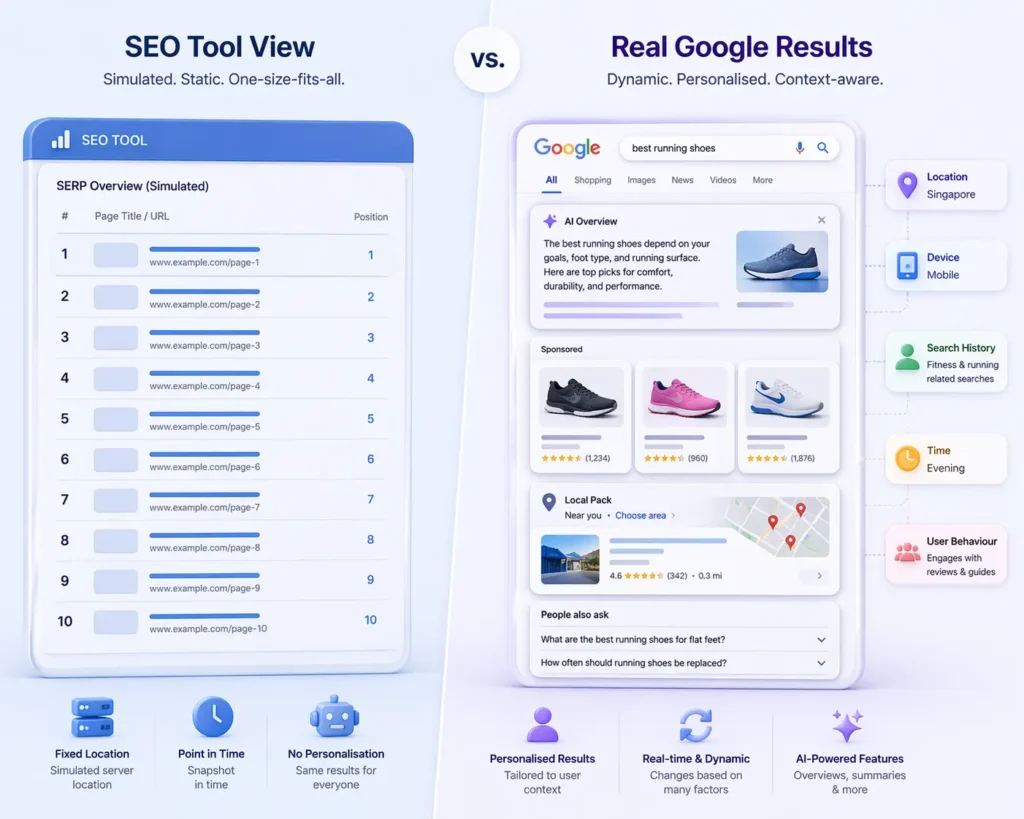
Getting discrepancies between SEO tools and actual Google results is becoming more frequent.
Keep in mind that some tools produce rankings that differ from Google’s in an SEO review because the data is simulated. SEO tools simulate searches from fixed environments, while Google results change in real time based on user context. This is why tool rankings often differ from what users actually see.
With the ever-changing landscape of Google search results, there is no longer a true ranking. Google’s results are dynamically ordered based on a variety of factors, and the behaviour of individual users will actually cause the rankings to fluctuate naturally.
Why Semrush and Google Rankings Don’t Match
More and more SEO tools are having trouble showing you what Google search rankings look like across devices because they simulate rankings — which is how a lot of SEO tools work, but no longer how search engine results actually work.
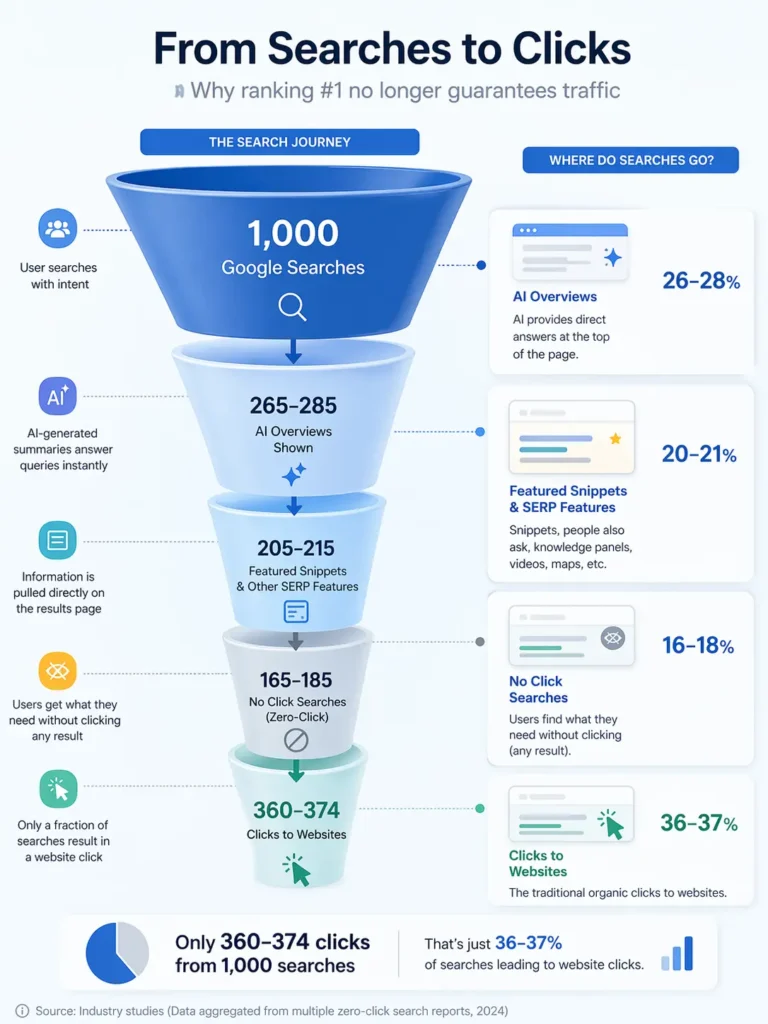
As a result, many searches are resulting in no clicks at all. Stats show that only 360–374 clicks per 1,000 Google searches are actually occurring, meaning ranking well in search results no longer guarantees real performance. However, for small business owners, Semrush and other SEO platforms are implementing new AI SEO tools and features to help track on-site visibility and make content more competitive in AI-generated search results.
Why Google Search Console Data Differs
Google Search Console (GSC) is now showing aggregated real-user data for search queries. This includes average position and impressions for all variations of a search query, which is very different from traditional rank-tracking software that reports a “snapshot in time” from a specific location. As Google results continue to change and are now displayed across different devices and contexts, having this type of information is crucial for proper keyword rankings.
For a deeper dive on how the many LLM-based SEO tools on the market identify how content appears in maps or in highlight summaries as part of a larger SEO strategy, check this out.
What Most Businesses Get Wrong About Rankings
The perception of rankings has recently shifted from seeing them as a static metric to a ranking that is variable, contextual and affected by filters implemented by AI-powered search algorithms. As a result of this shift, the focus has moved away from striving for an elusive #1 ranking and is now more about achieving visibility across multiple devices.
Why Do Google Rankings Fluctuate?
But what can influence your Google rankings? There are a number of factors that affect how your website ranks in results pages. These could include sudden changes in the Google algorithm, competition, recent changes on your website, or shifts in user behaviour and intent
As competitors update content, rankings naturally shift. But the user intent these efforts are aiming for is constantly shifting in often subtle but occasionally dramatic ways.
How Does Google Decide Which Results to Show?
Google considers a number of factors, including content relevance, content authority, and user intent. We recently reported that Google is now using AI to evaluate individual pieces of content as well as passages of content, which could result in content being summarised in the search results, or even used as a source in summary search results.
This shift has prompted more businesses to look for ways to rank in Google AI Overviews.
What Google Looks For
Google prioritises clear, relevant, credible answers.
How AI Has Changed Search Selection
Google is now extracting content, summarising articles, and pulling data from multiple sources to deliver a better search experience for users. As a result, the way businesses approach search engine optimisation (SEO) is being dramatically altered by the evolution of AI-driven search.
Why Structure Matters More Than Ever
Clear, well-organised content not only helps your site rank. Search results often pick the most accurate and concise pieces for their summary.
Why Traditional Rank Tracking Is No Longer Reliable
With so many variables at play in the increasingly dynamic search results pages, traditional rank tracking is becoming less reliable. In addition to personalisation, searches now come in a variety of flavours based on the device and format in which they’re displayed. Most importantly, user behaviour is also changing.
In fact, according to recent statistics, nearly 60% of Google searches now end without a click, meaning users often get AI-generated answers. This leaves many questioning whether ranking number one is enough to drive meaningful traffic.
Rankings are only one of many factors that influence user experience. As more businesses recognise the value of surface, cite or summary in AI-powered search results, more are shifting their focus from traditional SEO metrics to an outcome-based lens that measures performance of AI SEO effectively.
What Should You Track Instead of Rankings?
While ranking is still important, it is not the only KPI you should look at. You should also monitor visibility, impressions, CTR, and the number of AI Overviews. CTR for some search terms has plummeted as users get answers directly on the search results page, thanks to AI and featured snippets.
Stuck on how to use AI for SEO? Here’s a simple AI SEO plan for SMEs in Singapore to guide your strategy.
Frequently Asked Questions (FAQs)
Why do I rank differently on Google on mobile vs desktop?
Rankings differ because Google adjusts results based on device-specific intent and user context.
Are Google search results different for everyone?
Yes, due to personalisation and context.
How can I check my keyword rankings accurately?
Look at tools that can show you trends, but it’s even more powerful to look at real data from Google Search Console to see the actual searches for terms on
Final Takeaway and How to Rank with The Leading Solution
A frequent observation that search results on Google seem to differ at random has been overturned by Google itself, who reveal that results in fact differ because relevance is prioritised over consistency. But even ranking well in search results is not enough because Google users increasingly seek direct answers, whether as a snippet or a summary from Google’s AI-powered Knowledge Panel.
As search evolves, the focus shifts from chasing rankings to building consistent visibility across different contexts. Most importantly, you start to care less about #1 rankings and more about how your business ranks overall – across different devices and queries. Want to get on the right path? Work with an experienced AI SEO agency in Singapore.
About The Director
Notable Achievements


Struggling to Attract More Traffic?
Let us help! We provide various digital marketing services that can easily rank your website on the first page of Google such as:
Allow your website to be seen by more users by scheduling an appointment with us today!