
AI search is no longer a trend. ChatGPT processes an estimated 2-2.8 billion requests across a global user base. This reflects broader global AI adoption trends, in which usage is scaling faster than in previous technology cycles.
Is your brand visible in your customers’ answers? If your brand does not appear in AI-generated answers, it is excluded from consideration at that moment. Rather than relying on traditional rankings, retrieval and selection of relevant content occur at the point of the answer. This is where AI SEO services in Singapore become relevant, especially for those trying to make their brand appear in ChatGPT’s recommendations.
Quick Answer: How to Check Your Brand Visibility in ChatGPT
So, how do we check if ChatGPT recommends our brands in Singapore? We input a series of prompts, review the results for our brand, and check if our brand, products and services are mentioned, cited or recommended.
Test Singapore-specific queries repeatedly and document the results against the competition.
Why Brand Visibility in ChatGPT Matters for Singapore Businesses
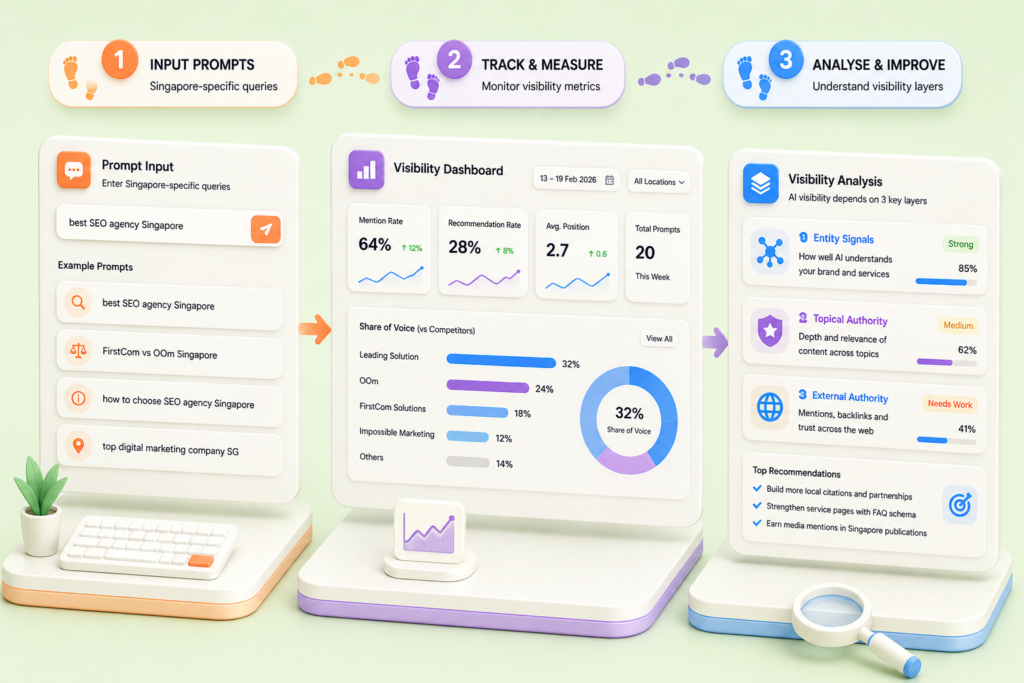
Users no longer scan multiple websites. AI systems consolidate options into a shortlist, and decisions happen earlier in the journey.
This matters because AI does not present ten results. It generates a single synthesised answer, which often features only a few brands.
In Singapore, this shift is already visible. Around 49% of consumers have used AI tools such as ChatGPT for shopping and product discovery, using them to filter options and identify relevant brands more efficiently.
Step 1: Define Singapore-Specific Prompts
Most businesses test visibility incorrectly.
They use generic prompts, thinking that AI systems operate generically. In reality, they operate based on Context, Intent and Location.
You need to test using Singapore-specific queries.
Commercial prompts
- “best SEO agency Singapore”
- “top interior design firm Singapore”
- “corporate tax consultant Singapore SME”
Comparison prompts
- “[your brand] vs [competitor] Singapore”
- “best alternative to [brand] Singapore”
Informational prompts
- “how to choose SEO agency Singapore”
- “what to look for in interior designer Singapore”
Testing such searches will show you that AI responses can vary depending on the wording of a given question.
While testing a single prompt can give you a sense of how your machine will perform on certain types of input, it doesn’t really give you much visibility.
Step 2: Run and Record Your Results
For each prompt, note whether your brand is mentioned, whether your brand is simply included in a list of brands or actually recommended, and where in the response your brand is mentioned. You can then compare results across all prompts to identify who and what are mentioned most frequently. Also, use this field to identify any blind spots.
Step 3: Understand What You’re Seeing
One common misunderstanding of the word “visibility” is that it means influence. Having “visibility” with your audience doesn’t mean you will generate leads. It simply means they know you’re out there. And, having your name mentioned is not enough. What matters is whether your brand is among the recommended startups across relevant queries.
Why Your Brand May Not Appear in ChatGPT (Singapore Context)
Most businesses assume the issue is content, but that’s only one part of the problem.
AI visibility depends on three layers:
Entity recognition gap
AI does not associate your brand strongly with your category.
This happens when your brand is new, but it can also happen if your website lacks topical depth and your positioning is unclear.
Local authority gap
Your brand lacks strong signals within the Singapore ecosystem.
AI doesn’t just evaluate your website — it checks all local directories, media mentions, partnerships and external references.
In fact, a significant portion of AI visibility comes from third-party sources, not owned content.
Content structure gap
Even if your content is strong, AI may not select it, simply because it is not structured for extraction.
Studies show that structured content can significantly increase AI visibility compared to unstructured pages.
Why Rankings Do Not Guarantee ChatGPT Visibility
This is where most businesses misunderstand the shift.
Ranking well on Google does not mean visibility in AI.
AI systems do not rank pages.
They:
- retrieve information
- evaluate relevance
- synthesise answers
Research shows that a meaningful percentage of AI-cited pages do not even rank on the first page of Google.
The implication is clear:
Visibility depends on extractability, not position, and this rule applies to broader search changes, such as how to rank in Google AI Overviews.
How to Measure ChatGPT Visibility Over Time
For this feature, there is no equivalent within Search Console to show how models are performing on AI. Therefore, you will not be able to view rankings as you currently do with Google Search Console. However, you can track how often brands are selected across different prompts and get weekly trending to gauge performance over time.
Prompt Coverage (Baseline Visibility)
Create 10 to 20 location-specific (e.g. “best SEO agency Singapore”) queries and run them once a week to track if your brand is showing up and how many times it’s showing up. From this, you should be able to get a coverage rate %, which is the closest we currently have to ranking presence for AI algorithms.
Share of Voice (Competitive Context)
These reports highlight the brands most frequently mentioned alongside others in AI-generated conversation data. In the report, you can view the full list of branded mentions for a given prompt and then calculate your brand’s visibility gap relative to your competitors. For example, if you’re mentioned 3 times out of every 10 relevant prompts where you could be mentioned, and your competitor is mentioned 7 times out of every 10 relevant prompts where they could be mentioned, then you have a visibility gap of 4 mentions per 10 prompts.
Recommendation Rate (Decision Influence)
Recommendation rate measures how often your brand is actively suggested, rather than simply mentioned. This distinction matters because AI systems frequently list multiple options but only recommend a small subset.
Traffic Signals (Indirect Measurement)
Check for referrals from sources such as ChatGPT and Perplexity, and also look for any increases in direct traffic, which is likely to be artificially generated and which pages on your site that traffic is for, which may match with your users’ information queries.
Branded Search Growth (Hidden Impact)
The study analysed both the depth and frequency of influence that different services have on consumers by measuring two criteria: First, after discovering a brand through a “brand + service” search query on an AI-powered search engine, does the consumer later conduct a search for the brand name alone? Second, how does the relative frequency of searches for a brand name over time compare to the industry average? These two criteria provided the basis for the report’s findings.
Assisted Conversions (Business Impact)
Analyse all multi-touch journeys and repeat visits to the site before conversion. AI will influence behaviour at the very beginning of the customer journey, but it is not always immediately apparent in the clickstream. A large proportion of searches end without a click, and AI will likely drive this trend.
What This Means
The LLM SEO framework is not a measure of traffic, but a way to understand influence. It evaluates how often your brand is retrieved and recommended by AI systems, shaping demand before users visit your site.
Visibility now creates influence before it creates traffic.
ChatGPT Visibility Tracking Dashboard (Singapore Framework)
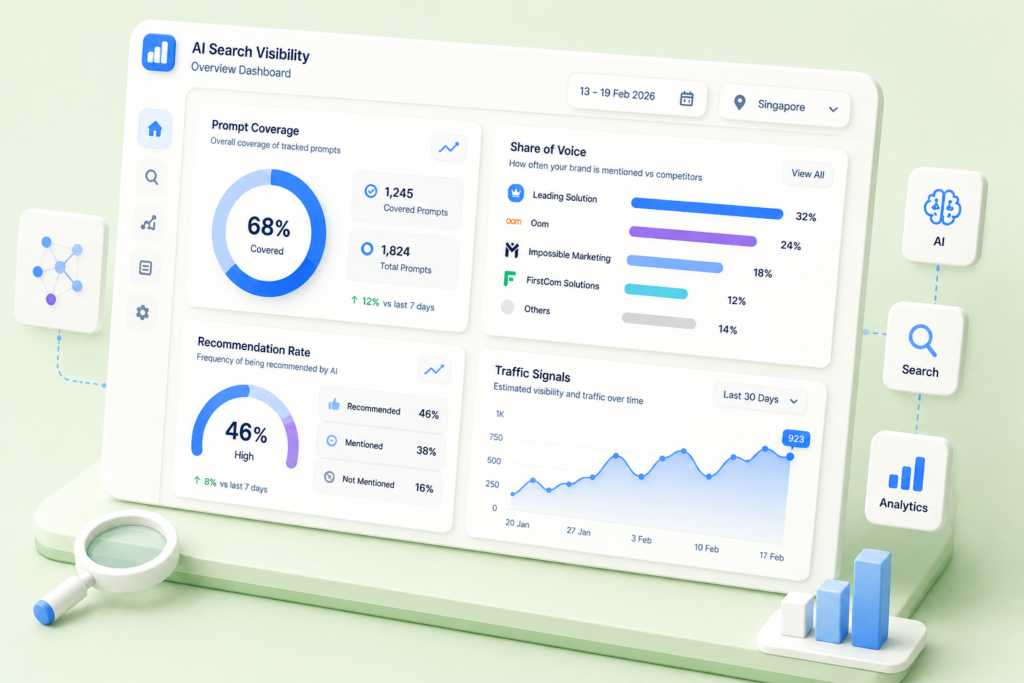
Running a few prompts gives you a snapshot.
To understand whether your visibility is improving, you need a simple way to track it over time.
| Metric | What to Track | How to Track | Why It Matters |
|---|---|---|---|
| Prompt Coverage | % of prompts where your brand appears | Test 10–20 Singapore queries weekly | Closest equivalent to “ranking presence” |
| Share of Voice | Frequency vs competitors | Count mentions across prompts | Shows a competitive visibility gap |
| Recommendation Rate | % of prompts where you are suggested | Track “recommended vs listed” | Indicates decision influence |
| AI Referral Traffic | Visits from ChatGPT, Perplexity, etc. | GA4 → check referral + direct spikes | AI traffic is often misclassified |
| Branded Search Growth | “Brand + service” searches | Google Search Console/trends | Signals AI-driven discovery |
| Assisted Conversions | Multi-touch conversions | GA4 → attribution paths | AI influences early decision stages |
What to Fix First If You’re Invisible
Once gaps are identified, prioritisation becomes critical.
Strengthen entity signals by clarifying positioning and aligning content with specific services. Build external authority through local mentions, partnerships, and industry coverage.
Improve content structure using answer-first sections, clear headings, and modular blocks. Extractability determines whether content is selected.
1. Strengthening Entity Signals
Our content service helps you link your content to your services and cements your company’s position within your industry by clearly communicating your position and core category.
Why does this matter? Your organisation’s content will be searched by an AI-powered search system and that system will return the most relevant results based on what it understands about the entities relevant to your organisation and your customers. For your organisation to appear in relevant search results, you must clearly position it to your customers as a relevant entity. If you are unclear, your organisation will not be retrieved when searched.
2. Building External Authority
While it’s important to monitor your website for mentions, also keep an eye out for posts that feature you in a partnership or article specific to your industry. Your brand is actively represented outside your website.
Your website will be viewed not only by AI but also by other authoritative sources (e.g., directories, press releases, citations) that will be weighed against it. The AI also views your website through a local Singapore lens.
3. Improving Content Structure
Use ‘answer first’ organisation, clear headings and brief definitions, and make content more digestible by reorganising it into content modules.
A common misconception amongst businesses is that providing ‘high-quality’ content is enough for AI to utilise. However, in addition to being of high quality, the content must also be extractable and retrievable by the AI.
When to Optimise for Citations
This guide focuses on diagnosis. After you identify the gaps, you can proceed with restructuring content, improving extractability, and aligning with AI retrieval patterns. This is where concepts like generative engine optimisation become relevant.
Final Thoughts
The search bar is no more. Now we have search boxes that give you the answer straight away.
The world is changing, and the search results page is about to become obsolete. People don’t want to peruse a list of search results pages anymore; instead, they just want to consume your most relevant answer.
Previously, trying to rank for things in order to get noticed was not as important as creating a position from which you can be found.
How to Move Forward
So why isn’t your brand showing up in ChatGPT? A few reasons (likely) and mostly to do with weak entity signals, limited local authority and poor content organisation.
Is your business showing up in AI-powered search results? Find out for yourself with an AI visibility audit.
About The Director
Notable Achievements

Struggling to Attract More Traffic?
Let us help! We provide various digital marketing services that can easily rank your website on the first page of Google such as:
Allow your website to be seen by more users by scheduling an appointment with us today!