

More Singaporeans are relying on AI, such as large language models, to assist them in searching and thus researching, considering, and making decisions about various options. And the market in Singapore is already quite advanced, with AI already widespread in the consumer and enterprise spaces.
This is part of a wider global shift. ChatGPT now reaches over 800 million weekly users and AI is now used by over one billion people worldwide, a new report has claimed. The report found that around one billion people worldwide use an average of five or six different applications containing some form of AI every day.
Businesses exploring structured approaches like AI SEO services Singapore are already adapting to this paradigm. Here’s how to jump on the GPT trend and get your Singapore service cited in ChatGPT:
How to Get Cited by ChatGPT (Quick Answer)
As far as I can see, you need to write content in clear chunks of single answers per section, reading well as a whole, and responsive to relevant questions. Each answer should be extractible, i.e. be independent of the surrounding content.
This means:
- placing the answer in the first sentence
- using clear headings that match search intent
- keeping sections focused on a single idea
- maintaining consistent terminology across pages
ChatGPT tends to select content at the passage level (i.e. individual paragraphs) rather than at the page level. As such, if a given paragraph is incomplete for the purpose of answering a question (i.e. you wouldn’t get a complete answer if that were the only output), it is unlikely to be cited as a reference.
Why Getting Cited by ChatGPT Matters in Singapore
Singapore is not an early-stage market.
Singapore is characterised by a high level of digital maturity, strong mobile-first behaviour, and a high level of AI adoption. According to the latest estimates, over 60% of the population in Singapore is already using AI tools. This puts the country at the top of the user charts in the field.
Locally, ChatGPT is still the leading AI chatbot, making up about two-thirds of the chatbot usage in Singapore. While the number of businesses integrating AI is continuing to grow, it’s becoming increasingly prevalent in workflows, customer experience and general customer intel.
This shift changes how users evaluate information.
More users are taking advantage of AI-generated results, ditching the old concept of manually reviewing websites. Instead, they opt for a quick answer provided by an algorithm that summarises information from multiple and the most authoritative and accurate sources. Such responses are becoming a significant part of the customer journey, determining the visibility of your business, perceived authority and whether your organisation makes it onto a short list.
How ChatGPT Chooses Sources
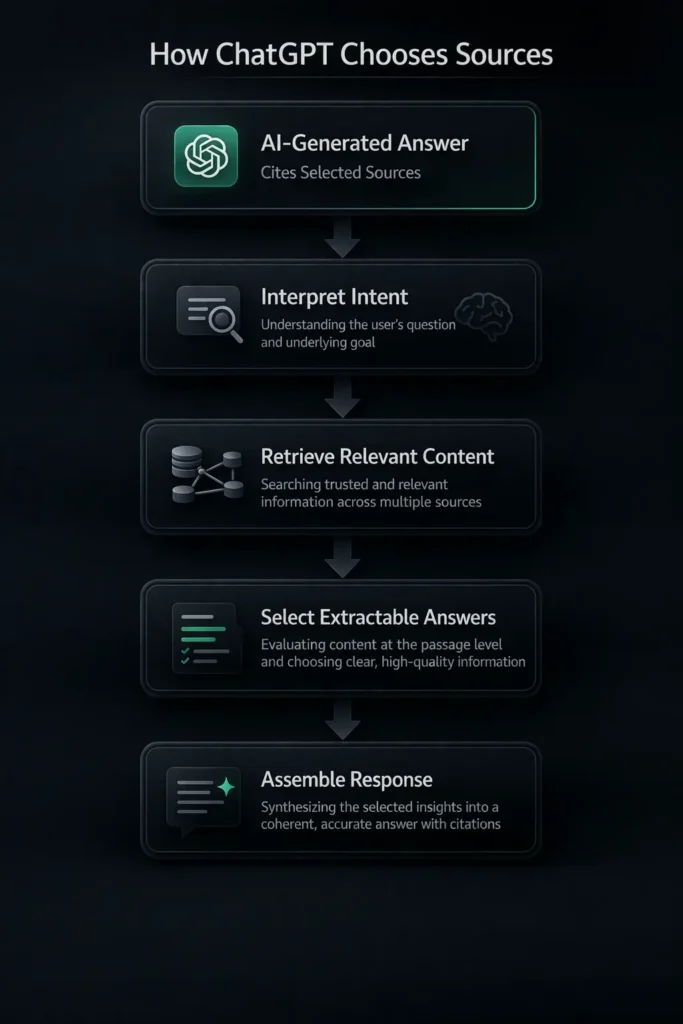
Understanding how ChatGPT selects sources requires a shift in perspective.
Traditional search engines rank entire pages. Large language models operate differently. They retrieve, evaluate, and assemble information at a much more granular level, often selecting specific passages rather than full documents.
This distinction explains why many well-optimised websites still fail to appear in AI-generated answers. The system is not asking “which page ranks highest?” but rather “which section best answers this query?”
AI Does Not Rank — It Selects
ChatGPT does not function like Google.
Instead of ranking pages, it follows a retrieval-and-generation process:
- It interprets the intent behind a query
- Converts both the query and content into semantic representations
- Retrieves relevant passages based on meaning
- Assembles a response using those passages
This approach relies on retrieval-augmented generation (RAG), in which the model searches for information before generating the response.
The main difference is that ChatGPT analyses content at the level of a single passage, so it can choose a particular paragraph or sentence as relevant – even if all the rest of the page is irrelevant. Similarly, a highly ranked page can be considered not relevant if it does not answer the user’s query.
From a structural perspective, this represents a shift from page-level optimisation to passage-level optimisation.
Why Most Content Never Gets Cited
Most content fails not because it lacks authority, but because it is difficult to retrieve and reuse.
Large language models rely on semantic retrieval, where meaning — not keywords — determines relevance.
When content is:
- long and unfocused
- written without clear answers
- dependent on the surrounding context
it becomes harder to isolate as a usable passage.
This creates a practical limitation because if your content is not selected at this stage, it will not appear in the final answer.
This explains a common pattern:
Even high-ranking pages often get ignored because they are not structured for extraction.
The AI Citation Framework
1. Clarity — Write Self-Contained Answers
Each section must stand on its own.
Instead of:
- long introductions
Use:
- direct definitions
- concise answers
2. Structure — Format for Extraction
AI reads in segments.
Use:
- short paragraphs
- bullet points
- clear headings
Avoid:
- dense content blocks
3. Topical Authority — Build Depth
One page is not enough.
You need:
- supporting articles
- consistent terminology
- internal linking
For example:
Structured topic coverage, such as LLM SEO, reinforces authority across related queries.
4. Entity Signals — Be Recognisable
AI evaluates:
- brand presence
- consistency
- credibility
In Singapore, this includes:
- local positioning
- service clarity
- real-world signals
5. External Validation — Go Beyond Your Website
You need:
- external mentions
- references
- cross-platform visibility
This strengthens trust.
How to Optimise Content to Get Cited by ChatGPT

Write Direct Answers First
Start with the answer.
This reflects how large language models retrieve information. Instead of reading entire pages, these systems retrieve specific passages that directly match a query, then assemble them into a response.
If your answer appears halfway through a paragraph or depends on the surrounding context, it becomes harder to extract. A clearer, self-contained alternative will usually be selected instead.
A more effective structure places the answer in the first sentence, followed by a supporting explanation. This increases the likelihood that your content becomes the primary unit selected during retrieval.
Use Question-Based Headings
Structure your content around how users actually search.
AI systems interpret queries by breaking them into smaller intent components and matching them against semantically similar content. Headings that mirror real questions improve alignment with this process.
Phrases such as “How does ChatGPT choose sources?” or “How to appear in AI answers?” act as clear signals, helping the model map your content directly to user intent.
AI does not retrieve pages in full. It retrieves answers to sub-questions. When your headings reflect those sub-questions, your content becomes easier to locate and reuse.
Keep Sections Focused
Each section should communicate a single idea clearly and independently.
Large language models process content in smaller segments and match them based on meaning. When a section mixes multiple ideas or depends on earlier context, it becomes less precise as a retrieval unit.
A simple test applies here:
If a section is extracted on its own, does it still make sense?
If it does, it aligns with how AI systems retrieve and reuse content.
Reinforce Topic Coverage
ChatGPT does not evaluate content in isolation. It builds confidence through repeated signals across related pages.
When your site consistently covers a topic with aligned terminology and structured explanations, it strengthens semantic relationships. Internal linking supports this process.
For example:
Supporting resources such as the best LLM SEO tools expand topic depth and reinforce relevance across related queries.
This improves how your content is interpreted during retrieval.
Align Content with Meaning, Not Keywords
Traditional SEO focuses on keywords. AI systems focus on meaning.
Modern retrieval compares semantic similarity between queries and content rather than exact phrasing. This means your content should prioritise clear explanations over keyword repetition.
When your content reflects the intent behind a query, it becomes more adaptable across different variations.
Structure for Reuse, Not Just Reading
The core shift is this:
You are not just writing for users.
You are writing for systems that reuse your content.
AI models retrieve, assemble, and summarise information. Content that performs well is modular, self-contained, and logically structured.
This determines whether your content is simply read or actually selected.
Common Mistakes That Prevent AI Citations
- Over-relying on rankings: Ranking alone does not guarantee citations.
- Using generic global content: Singapore queries require local relevance and contextual depth.
- Ignoring structure: Poor formatting reduces extractability.
- Treating AI as separate from SEO: This is a structural mistake.
ChatGPT vs Google AI Overviews
| Aspect | ChatGPT | Google AI Overviews |
| Role | Generates full answers | Summarises search results |
| Interface | Conversational (chat-based) | Embedded in Google search |
| Source Selection | Selective, passage-level | Broad, ranking-influenced |
| Citation Style | Fewer, more deliberate | More frequent, rotating |
| User Intent | Decision-making, comparison | Research and information |
| Answer Format | Detailed, narrative | Concise, summarised |
| Dependency | Semantic relevance | Search rankings + authority |
| Visibility Goal | Be part of the answer | Be cited as a source |
Similar to ChatGPT, Google AI Overviews also aggregate content from the web, but they are a bit different. They are still very dependent on current authority, ranking, and content structure, but they now draw from a wider range of sources and surface that content in more places. With Overviews, Google is now pulling from a larger set of sites, rotating the citations across different results pages and sometimes even across different search queries. This makes Overviews a great feature for the early stages of research when you want a brief look at the types of sources that are available before you start to visit many sites.
While Google AI Overviews is designed around the Google Search algorithm that ranks results based on authority and breadth of coverage, ChatGPT ranks and selects output based on the relevance and readability of individual portions of text. Furthermore, while Google’s cited sources are designed to be comprehensive and relevant to the intent of the answer, in cases where the user is looking for a recommendation or answer to a question or task, ChatGPT tends to provide a smaller set of sources that are more in line with what the user is asking for. This points to a structural difference in how these two systems are designed, reflecting different conceptions of how and why output should be made visible to users.
FAQs About ChatGPT SEO
What is ChatGPT SEO?
ChatGPT SEO is all about ensuring your content is AI-friendly. The primary focus here is on how easily content can be found, extracted, summarised and included as citations in AI-generated responses.
What Makes Content AI-Friendly?
AI-friendly content is easily extractable by large language models. This includes brief subheadings, brief definitions, a regular, consistent structure, and uniform terms and naming conventions throughout the text.
How do I get my website cited by ChatGPT?
To get cited, structure your content with clear answers, short sections, and strong topical authority. AI models prioritise extractable content that directly addresses user intent.
Does ranking on Google help with ChatGPT citations?
Ranking might help but ChatGPT prioritises content primarily based on clarity, structure, and relevance at the passage level.
What type of content does ChatGPT prefer?
ChatGPT prefers definition-style answers with structured sections, consistent terminology and high authority.
AI-Ready Summary
To get cited by ChatGPT:
- Write clear, standalone answers
- Structure content for extraction
- Build topical authority across pages
- Strengthen entity credibility
- Reinforce signals with external validation
Final Take
Getting cited by ChatGPT is not a tactic.
Relevance describes how well your content matches the way that artificial intelligence (AI) and digital systems process and think about information.
How is Singapore feeling about the shift in search behaviour due to AI? Find out here. In Singapore, where we have one of the highest AI penetration levels and the most frequent use, these trends will impact how businesses are discovered.
Conclusion & How to Get Cited Properly with The Leading Solution
If your current strategy focuses only on rankings, you are addressing only part of the visibility layer. What you need to do is create structured content with clear answers and consistent authority. While these checks will guarantee a natural flow of citations from all LLMs, you’ll likely need professional help with continuous optimisation. If you are looking to build that structure properly, you can inquire with our SEO experts at The Leading Solution for a personalised site audit and quote.
About The Director
Notable Achievements


Struggling to Attract More Traffic?
Let us help! We provide various digital marketing services that can easily rank your website on the first page of Google such as:
Allow your website to be seen by more users by scheduling an appointment with us today!