

Search is evolving and LLM SEO has “entered the chat” — quietly, but profoundly.
For years, SEO followed a familiar pattern. You optimised pages, built authority, climbed the rankings, and waited for users to click through from search results. But the way people find information has already taken a sharp turn.
Instead of scrolling through links, many users now ask AI systems directly. Tools such as ChatGPT, Gemini, Perplexity, and Google’s AI Overviews analyse multiple sources and generate a summarised response. This change is already visible in Singapore, where recent research shows 86% of students and 67% of employees in Singapore have used generative AI tools.
In other words, search is shifting from “links to explore” to “answers delivered instantly.” And while this opens up an entirely new challenge, you may still influence the answer — even if users never see the page itself.
That shift is exactly why LLM SEO is becoming increasingly important.
What Is LLM SEO?
LLM SEO is all about structuring the content on your website so that large language models can discover, read, and index it and include it in the answers they generate.
Unlike traditional SEO in which the primary focus is to help pages rank in search engines, LLM optimisation adapts content for models such as ChatGPT, Gemini, and Perplexity. For example, large language models analyse queries by interpreting concepts, context, and relationships among ideas rather than relying solely on keyword matching.
This shifts the entire outlook on the way optimisation works. Now you optimise for findability, readability and citeability rather than rankings.
Put simply:
- Traditional SEO helps people find your page
- LLM SEO helps AI use your page
Key Takeaways about LLM SEO
LLM SEO is not just a trend – it’s essentially traditional ways reinvented through these core ideas:
- LLM SEO focuses on helping AI systems retrieve and cite your content.
- Many AI search systems rely on retrieval-augmented generation (RAG) to gather external information.
- Clear explanations and structured content increase citation likelihood.
- Websites with strong topical authority appear more often in AI-generated answers.
- Businesses that adapt early may gain an advantage as AI-driven search expands.
How AI Systems Retrieve Information From Websites
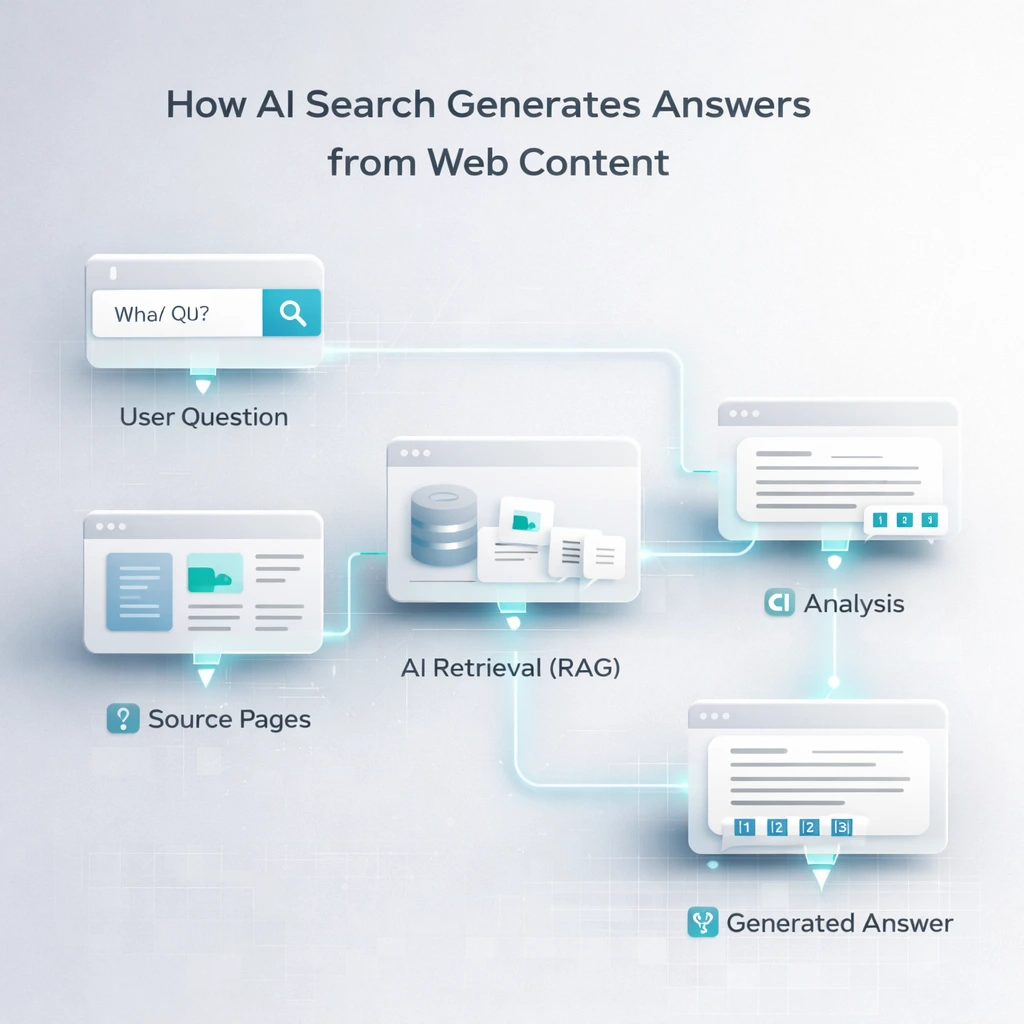
Optimising for AI search begins with understanding how these systems retrieve information. In most cases, AI platforms use retrieval-augmented generation (RAG).
This method does not rely solely on training data. Instead, the model retrieves relevant documents from external sources and uses them as context when generating an answer.
The process usually follows four steps:
- A user asks a question.
- The AI retrieves relevant webpages or documents.
- The model extracts key information from those sources.
- The AI generates a summarised response.
In effect, the AI becomes an intermediary between users and information. Your page may contribute to the final answer even if the user never clicks the link.
This means visibility now depends not only on rankings, but also on whether your content is clear enough for AI systems to interpret and reuse.
Example: How AI Uses Web Content
When a user asks a question such as “What is LLM SEO?”, an AI system may retrieve several webpages explaining the concept. The model then synthesises those explanations into a single response while citing selected sources. Pages that provide clear definitions, structured headings, and concise explanations are far more likely to appear in those citations.
With over 80% of university students and more than 60% of employees already using generative AI in their daily activities, AI-generated answers are becoming increasingly influential in the way users in the Asia-Pacific region discover information online.
Why AI Systems Prefer Some Websites Over Others
Notice how an AI-generated answer might include some webpages and ignore others? Some sites appear repeatedly as reference sources, while others rarely surface. There are several factors that influence this.
Topical Authority
AI systems favour websites that demonstrate consistent expertise on a subject.
Publishing multiple articles on the same topic signals deeper expertise and trustworthiness.
That’s why so many SEO teams are using AI Keyword Research and AI Content Gap Analysis to uncover new gaps to cover.
The more you cover on your chosen topics, the more likely the search engines will view your site as a reliable authority.
Content Clarity
AI models extract information before generating answers.
Pages that explain ideas clearly and directly are easier for models to interpret.
Clear definitions, structured explanations, and concise paragraphs significantly improve retrievability.
Structured Information
Headings create semantic structure.
They help AI systems identify relevant sections quickly and understand how ideas connect.
Well-structured articles often perform better in both traditional search results and AI-generated responses.
Credibility Signals
Expertise still matters.
Author credentials, reliable sources, and consistent information strengthen trust signals.
In many cases, successful LLM SEO comes down to owning a concept with depth and credibility.
What Content Structures Do LLMs Prefer?
Large language models can interpret almost any webpage, but certain structures make information significantly easier to retrieve.
Interestingly, these structures also improve traditional SEO performance.
- Clear Definitions: Start important sections with concise explanations. AI systems frequently extract these definitions when generating answers.
- Logical Headings: Structured headings create a clear hierarchy that helps AI models interpret the page.
- Step-by-Step Explanations: Models consider content that breaks down the process of how to complete a task by listing out individual steps in order to be more helpful.
- Concise Paragraphs: Short paragraphs lead to fewer ambiguities and are easier to pick up by AI.
- Comprehensive Topic Coverage: Strong topical coverage cements your semantic relevance. Keywords gap analysis is an effective way to uncover relevant subtopics. A series of interconnected content pages can help create a topic cluster on your website that shows your authority in the given field.
5 Practical Ways To Improve LLM SEO
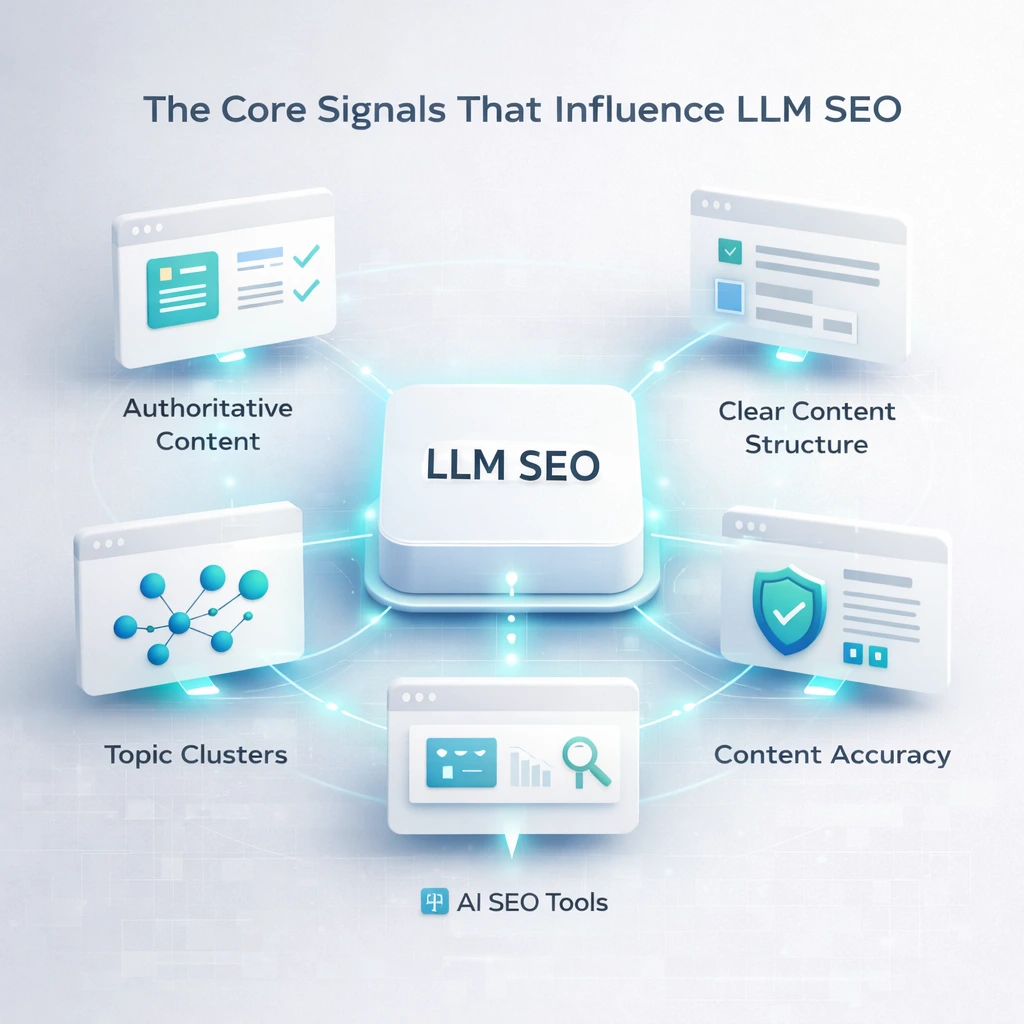
The common belief that the only way to optimise for the future of search in an AI era is to ditch all things SEO is simply not true. In reality, adapting content for new search channels is a fantastic way to complement existing practices. With many organisations across the region increasing investment in generative AI technologies, the shift is clear. As AI answers grow, a strong LLM SEO strategy helps ensure your content is retrieved and cited.
Publish Authoritative Content
Depth matters more than volume. Longer, more well-researched content will often outperform shorter, more superficial pieces.
Structure Content Clearly
Use logical headings and subheadings, brief sentences and simple explanations. The easier your content is to read, the easier it is for AI to understand.
Build Topic Clusters
Publishing related articles strengthens topical authority. For example, many online businesses develop specialised strategies around AI ecommerce SEO to improve visibility across product-related searches.
Maintain Content Accuracy
AI systems depend on reliable sources. Editorial oversight helps ensure your website produces compliant AI SEO content that remains trustworthy.
Use AI Tools Strategically
The number of optimisation tools continues to grow. Many marketers experiment with different AI SEO apps to analyse content gaps, monitor performance, and identify optimisation opportunities.
Examples of AI Search Platforms Using LLM Retrieval
Several modern platforms now rely on large language models to generate answers rather than simply displaying links.
ChatGPT
ChatGPT retrieves and synthesises information from multiple sources when answering complex queries.
Google AI Overviews
Google integrates generative AI directly into search results, summarising information from several webpages into a single response.
Perplexity
Perplexity functions as an answer engine, retrieving sources and generating responses that frequently include citations.
Gemini
Google’s Gemini model also incorporates external information retrieval when generating responses, allowing it to produce more current answers.
LLM SEO Checklist
If you want a practical framework, use this checklist when reviewing your content.
LLM SEO Checklist:
- Start the article with a clear definition
- Use structured headings and logical hierarchy
- Write concise paragraphs that explain ideas clearly
- Cover related subtopics to strengthen topical authority
- Include expert insights or supporting evidence
- Maintain consistent terminology throughout the article
- Support claims with credible sources
- Interlink related articles within topic clusters
- Update content regularly to maintain accuracy
- Ensure the page remains readable for both humans and AI systems
The goal is not simply to rank in search engines.
The goal is to become a trusted source that AI systems reference when answering questions.
FAQs about LLM SEO and AI Search
What is LLM SEO?
LLM SEO refers to structuring website content so large language models can retrieve and cite it when generating AI-powered answers.
How do AI systems retrieve information from websites?
A large number of modern AI applications are based on a technology called retrieval-augmented generation, which trains a model to summarise or answer questions by retrieving relevant documents from external sources and then using them in the output.
How is LLM SEO different from traditional SEO?
Traditional SEO is about getting your webpages to rank in the search engine results pages (SERPs). LLM SEO is about increasing the likelihood that your webpages will be selected as sources for AI to generate answers for users.
Can businesses optimise their websites for AI search?
Yes. Businesses can increase visibility for their site by publishing authoritative content, presenting information clearly and becoming authorities in a specific topic.
Is LLM SEO replacing traditional SEO?
No. Traditional SEO still provides the foundation for visibility. LLM SEO extends that foundation by making content easier for AI systems to retrieve and summarise.
Final Thoughts
SEO is undergoing an evolution that’s completely changing how AI answers user search queries. Instead of returning a list of URLs that answer the query, modern search engines focus on retrieving and combining multiple answers to best satisfy the search. And while, at their core, things don’t change much, one still needs to be publishing meaningful, easy-to-understand content that shows real authority on topics.
We at The Leading Solution can certainly help you fine-tune all of these to ensure you are optimised for AI. Inquire with us for our AI SEO services in Singapore to get a better idea of how to implement these simple yet vital principles.
About The Director
Notable Achievements


Struggling to Attract More Traffic?
Let us help! We provide various digital marketing services that can easily rank your website on the first page of Google such as:
Allow your website to be seen by more users by scheduling an appointment with us today!