
Have you noticed a reduction in organic clicks, impressions, and average position over time for a URL that has previously performed well? According to Ahrefs, this is the perfect example of content decay, a gradual decline of your site’s performance over months, as opposed to a penalty.
This is not a seasonal dip. Nor is it your AI Overview stealing all your clicks whilst your ranking holds. Nor is it that one missing Singapore price/use case/regulator name on your page.
By the time you’ve written 2 years’ worth of blog posts, every marketing manager will have asked the same question at some point or another: do you write more or do you fix what you already have?
What Content Decay Actually Is (And What It Is Not)
Search Console reports decay as a trend in impressions, clicks, and position over time. This means that a page that used to rank well on page 1 of search results will start to drop in position over time until it reaches page 2 or below. At the same time, the number of impressions and clicks on the page will start to decline.
Three things get mislabelled as decay:
- Seasonality: While tuition, for example, will see a spike in queries before each exam, retail-related searches will increase before each festive period. It is important to compare the previous year to the current year, rather than month by month, to determine whether true decay is occurring.
- SERP-feature click loss: The click rate for a URL falls while the impression rate for that URL stays the same or even increases. Search Engine Land outlines the types of content decay in 2026. Here’s a summary of zero-click capture.
- Local relevance gaps: These are pages that never even mentioned SGD, MOE, IRAS, etc. (for a Singapore use case) in the first place. So, in a sense, they haven’t decayed. What needs to happen is an update of the under-specified page.
Hours are a scarce resource for in-house SEOs. If they get this wrong, they will waste that resource on something that wasn’t a problem in the first place.
The four buckets — and the rule for each
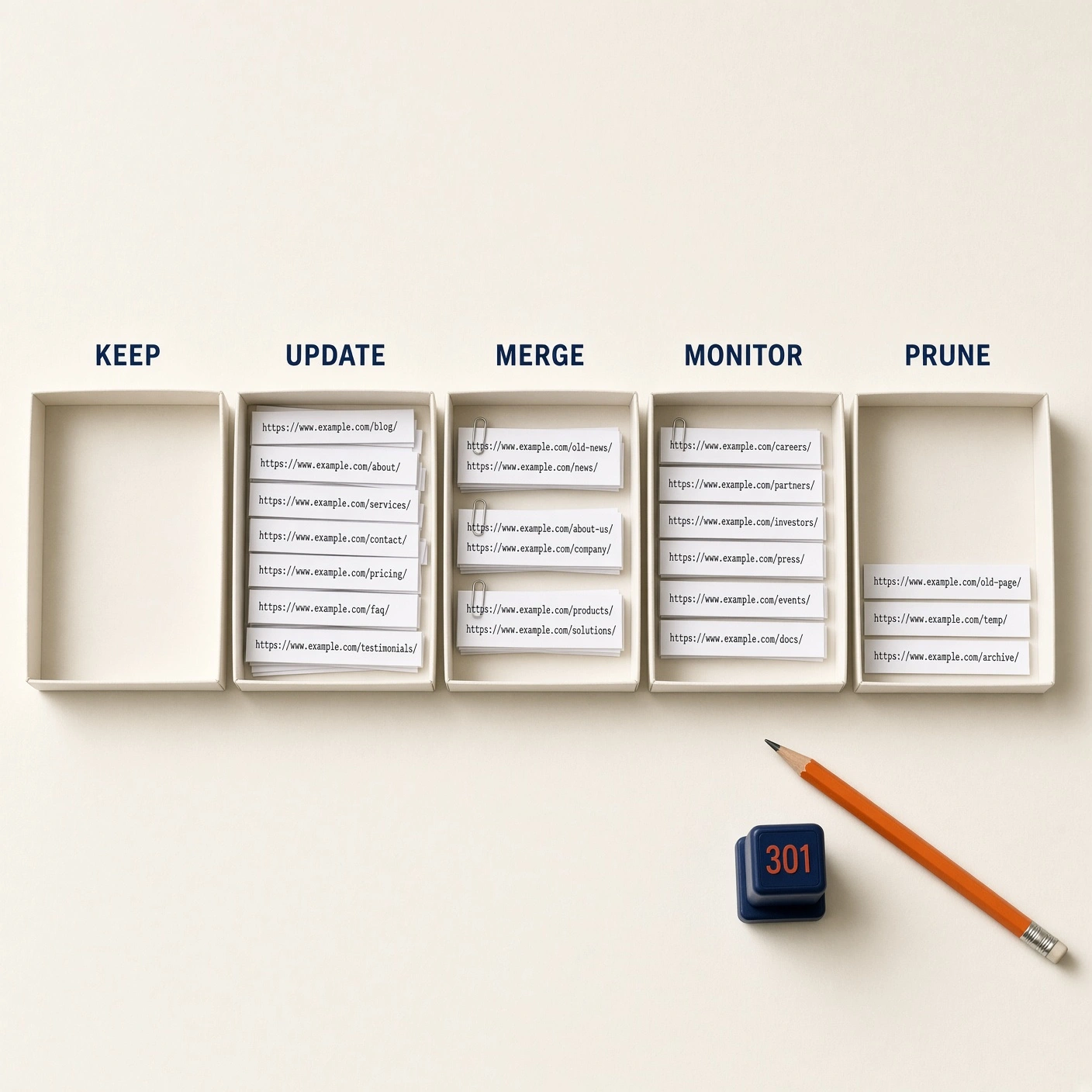
A content audit for SEO is not an inventory. It is a decision per URL. That’s why we run every indexable blog post through four rules. If a URL fails the first, it goes to the second, and so on.
| Bucket | Rule | Action |
| Keep | Position ≤ 4 and clicks stable over 6–12 months. | Leave it. Do not rewrite a working page. |
| Update | High impressions, position 5–20, or a dated H1 / year-stamped title. | Refresh facts, intent match, internal links. Keep the URL. |
| Merge | Two URLs share ≥ 3 of the same top queries. | Keep the stronger URL. 301 the weaker. Move the unique sections across. |
| Prune | No impressions, no links, no internal purpose. | 301 to the nearest useful parent, or noindex if nothing relevant exists. |
Keep is rare on a young SME blog, but that’s totally fine. The point of the rule is to stop a well-meaning rewrite of a page that is already doing its job.
Update is where most of the recovery lives. Position 5–20 with impressions means Google already understands the page. The content is the lagging part.
Merge is how you stop keyword cannibalisation. If two posts split the same three queries, neither will hold a stable position. That’s where we do content pruning in the popular sense. We delete everything quiet that brings 0 results.
A fifth bucket we added: Monitor
The four-bucket model assumes every URL is ready for a verdict this week. Real libraries are not. We added Monitor for pages that have some impressions, no clear decay trend, and no commercial or cluster role yet.
Monitor exists so the team does not force a prune on a page that has not had time, or force an update on a page that is not worth the hours. Review the bucket in 90 days. If impressions have gone to zero and nothing links to it, it moves to Prune. If a query appears and its position is 5–20, it moves to Update.
Without Monitor, audits over-prune. Over-pruning is how you delete the page that would have become a spoke.
Worked example 1: our own library
In July 2026, The Leading Solution’s resources library — 90-plus posts — returned about 39 ranking keyword rows in total. That is not a publishing problem. That is a concentration problem, and it is the 80/20 rule in SEO showing up in our own Search Console.
Five duplicate pairs were actively competing with each other:
- Future of SEO — July 2024 vs September 2025.
- SEO vs SEM — February 2024 vs July 2024.
- Image alt text — November 2023 vs October 2024.
- Small-business SEO — November 2023 vs January 2026.
- Cornerstone content — two URLs, same job.
Two ranking pages were not linked from the resources index at all. But they were not decaying because the writing was weak. They were decaying because the site had forgotten they existed. That is a Code problem in the 3 C’s of SEO — Content, Code, Credibility — not a reason to commission another post on the same topic.
| Keep | Update | Merge | Monitor | Prune |
| 0 | 35 | 14 URLs / 12 groups | 48 | 3 |
Keeping it at zero is the uncomfortable number. It means nothing in the library is both top-four and stable. The work is therefore Update and Merge, not a new editorial calendar. The 14 merge URLs sit in 12 groups — most groups are pairs, which is typical. You do not need a new cluster. You need one surviving URL per group and a 301.
Worked example 2: a 224-page tuition site
We ran the same Google Search Console decay audit for a Singapore tuition centre with 224 indexed pages. Education sites accumulate programme, level, subject, and location URLs faster than any editor can keep up with. After two years, the library looks large. The query map does not.
The pattern was familiar. A thin set of subject guides still earned impressions and belonged in Update — dated examples, old exam-year references, H1s that no longer matched how parents search. A set of overlapping syllabus pages shared the same top queries and belonged in Merge. A long tail of programme and location variants had no impressions, no referring domains and no internal role beyond sitting in the index. Those went to Prune or noindex.
Ninety days after the first round of updates and merges, the refreshed guides recovered impressions on the queries they already ranked for. The merged URLs stopped splitting clicks. The pruned URLs left the index. Nothing dramatic happened to domain-wide traffic in week two, as you should expect. Decay audits pay off on the pages you touch, over a quarter, not on a Monday morning graph.
2 traps to avoid when addressing content decay
Pruning pages that still hold backlinks
Historic URLs on our own domain (from the pharma-spam injection) are worth nothing as content, but they still hold referring domains. If you 404 these pages, then you throw the links away. If you 301 these old pages to a relevant parent page, you keep the equity inside the site. If no parent page is relevant, then you can use a simple holding page instead.
The prune rule: no impressions, no links, no internal purpose. You do not prune. You redirect. This is the same hygiene we run in an SEO audit before anyone discusses deletion.
Merging pages that serve different intents
These are two different kinds of pages. One explains content pruning; the other sells content audits. Even though both mention “content audit SEO” for example, one is informational and the other is commercial. Glueing both together would result in a page that Google cannot classify for either search intent and therefore will not rank for either.
This means, for purposes of merging pages, we look at the Search Console query list, not at the page titles. If the queries overlap, merge. If they don’t, then leave both and link between them.
A 90-minute version for a site under 100 pages
You don’t need to run a 6-week program to run this on a small site.
- Minutes 0–20: Export last 16 months of pages from Search Console. Sort by clicks, then impressions, then position.
- Minutes 20–40: Tag each URL Keep / Update / Merge / Monitor / Prune using the rules above. Do not debate. Use the rule.
- Minutes 40–60: Check referring domains on every Prune candidate. Move any with links into Redirect.
- Minutes 60–75: List merge groups. Pick the surviving URL in each group — usually the one with more clicks or more links.
- Minutes 75–90: Write the sequence for the next two weeks: update the position 5–20 pages first, then fire the 301s, then look at new briefs.
The 90 minutes of work are followed by hours of editing to implement all the redirects and write briefs for new content for the top pages.
Why this now sits inside AI SEO
The blue links to ranking stale pages (with old content) will lose their corresponding AI Overview and ChatGPT citations first, since ChatGPT prefers maintained sources over stale ones. A decay audit is how an AI SEO programme keeps the pages it already earned — the same pages you are trying to get cited by ChatGPT.
If the question you are really asking is whether publishing still matters at all, start with our honest answer on whether SEO is dead in 2026. This means the version of SEO that ships a post and then does nothing with it (i.e. leaves it to decay) is dead. But that doesn’t mean all SEO is dead – the version that decides to Keep, Update, Merge or Prune your published content is not.
Fix, then merge, then write
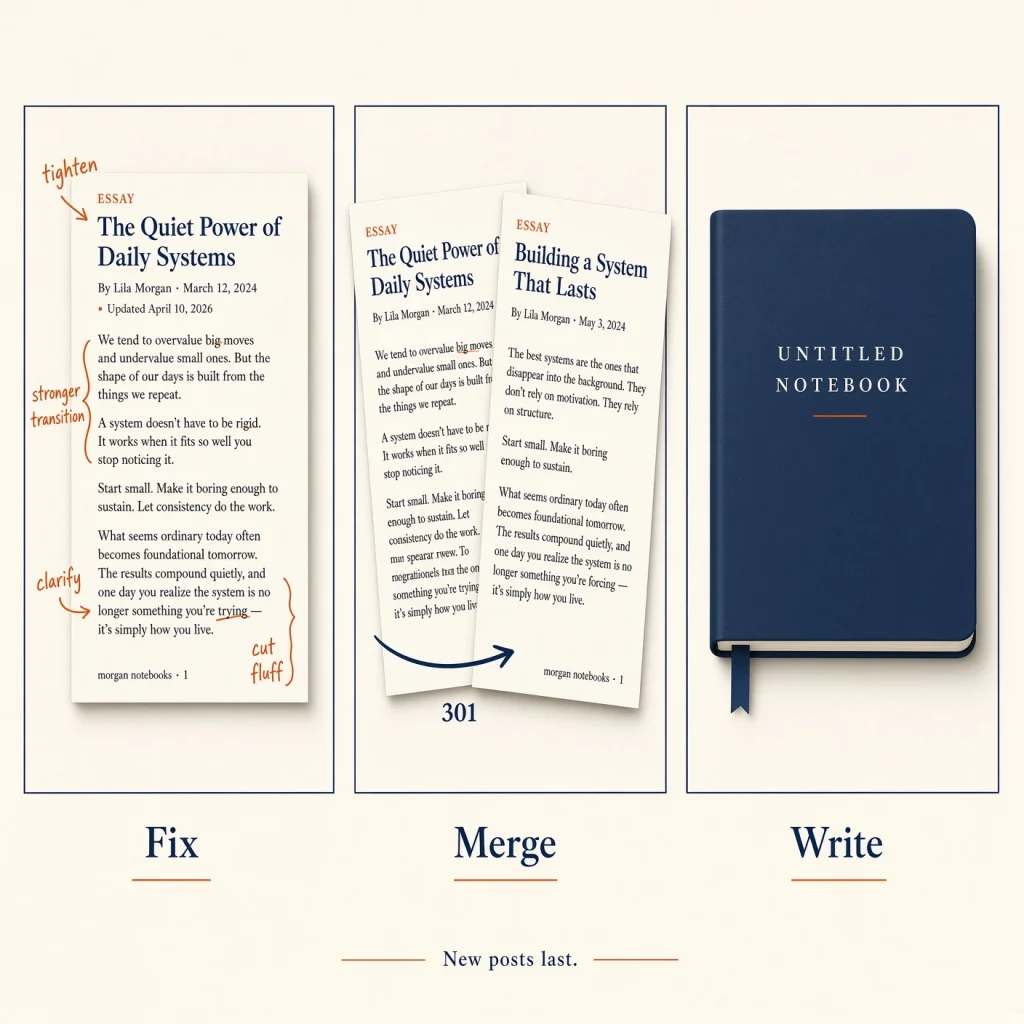
The sequence is the strategy.
- Fix the Update bucket. These pages already have impressions. They return traffic fastest.
- Merge the duplicate pairs. One URL per query set. 301 the rest. Point internal links at the survivor.
- Prune only what has no impressions, no links and no job on the site. Redirect, do not vanish.
- Write new posts last, and only for queries no surviving URL covers. Tie new pieces back to your cornerstone content so the library has a centre, not another orphan.
Most SME blogs we see do this in reverse. They brief the next article while two older articles fight over the same three queries. That is content decay you scheduled yourself.
FAQs
How is content decay different from a traffic drop after an algorithm update?
An algorithm update affects many URLs on the same date, whereas decay is gradual for a single URL over months.
Should I noindex or 301 when I prune?
301 to the nearest useful parent if one exists. Noindex if the URL must stay live for users — a login page, a thin thank-you page — but should leave the index. Do not 404 a URL that still has referring domains.
Can a decaying page still be cited by AI Overviews or ChatGPT?
Yes, briefly. Then it gets replaced by a fresher source. If you want the citation to persist, the page must remain accurate. That is an Update, not a new URL.
How often should a site under 100 pages run this?
A full pass once a year. A 90-minute GSC pass every quarter on the top URLs by impressions. Do not rebuild the taxonomy every month.
Conclusion
Content decay is not a reason to stop blogging. It is a reason to stop treating the archive as finished work. The decision is mechanical: Keep what already ranks in the top four with stable clicks. Update what Google still shows but users no longer choose. Merge what is fighting itself. Monitor what is too early to call. Prune only what has no impressions, no links and no purpose.
If you want a second pair of eyes on the bucket list — or you would rather not spend a quarter learning which of your own posts are cannibalising each other — we run this as part of the work at The Leading Solution. Tell us what the library looks like and we will tell you which URLs to touch first.
About The Director
Notable Achievements


Struggling to Attract More Traffic?
Let us help! We provide various digital marketing services that can easily rank your website on the first page of Google such as:
Allow your website to be seen by more users by scheduling an appointment with us today!