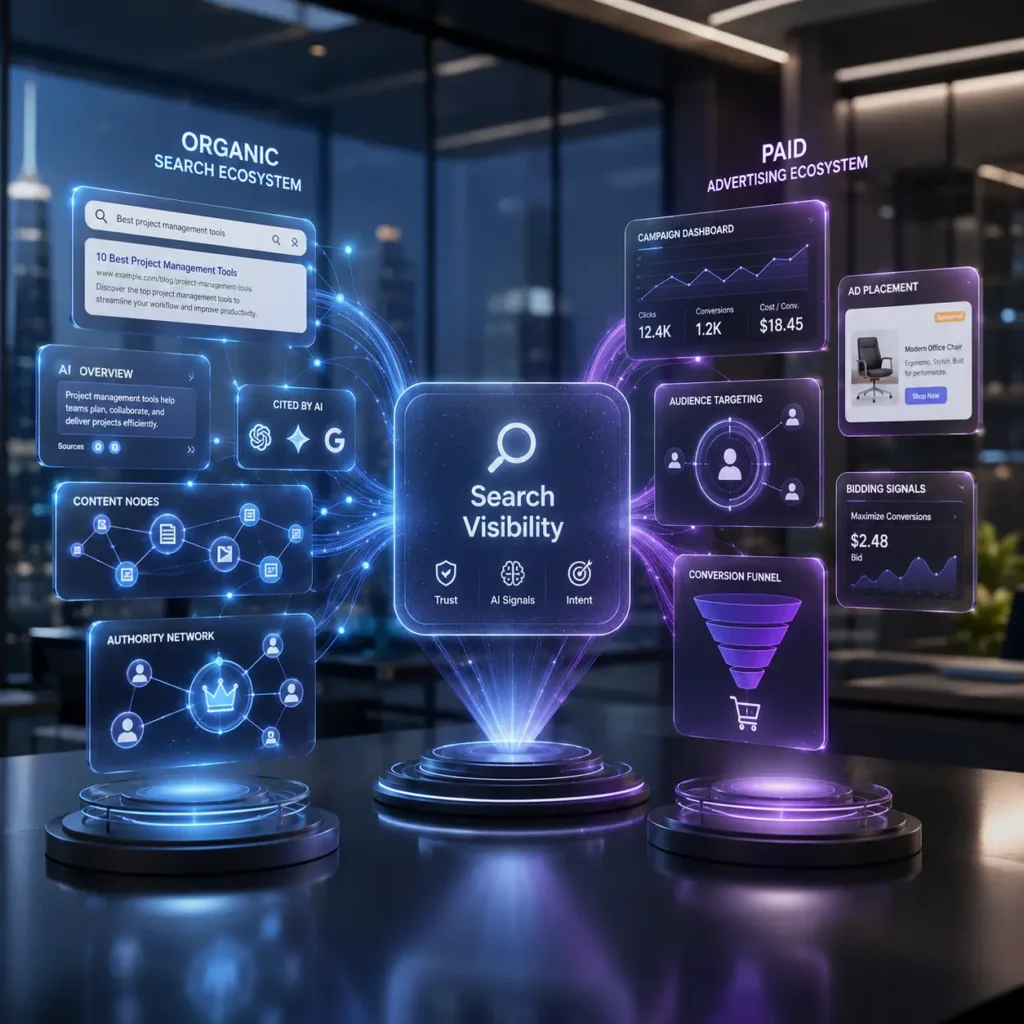
Businesses have traditionally compared organic traffic and paid traffic as separate acquisition strategies. And while each operates through different economic and visibility models, both channels continue to play important roles in digital marketing.
What’s new is that AI is changing how visibility works. AI Overviews, zero-click behaviour, and AI-powered search results are reducing the direct relationship between rankings and clicks. As search behaviour evolves, businesses increasingly need to evaluate not just traffic volume, but how discoverability, trust, and visibility function across modern search ecosystems — particularly within broader AI SEO services strategies.
What Is Organic Traffic?
In web analytics, organic traffic refers to website traffic generated from unpaid or organic search engine results pages (SERPs). In other words, the web traffic of a website that is visited from organic search results, such as Google, Bing, Yahoo, etc.
What Is Paid Traffic?
Paid traffic refers to visitors to your website who arrive via paid advertising. This can happen on various platforms, including Google Ads, YouTube Ads, Meta Ads, and even other search engines or social media sites where you pay for sponsored content.
Compared to organic traffic, paid traffic can deliver visibility almost instantly, which is why paid acquisition is a great channel for product launches, lead-generation campaigns, and other activities where you need to ramp up traffic quickly for short-term ecommerce promotions.
Of course, paid traffic requires continuous investment to keep up with increasing competition and remain visible for your content. In contrast, with organic search, the returns on your investment can continue compounding long after you have stopped investing further time or effort.
Organic vs Paid Traffic: The Differences
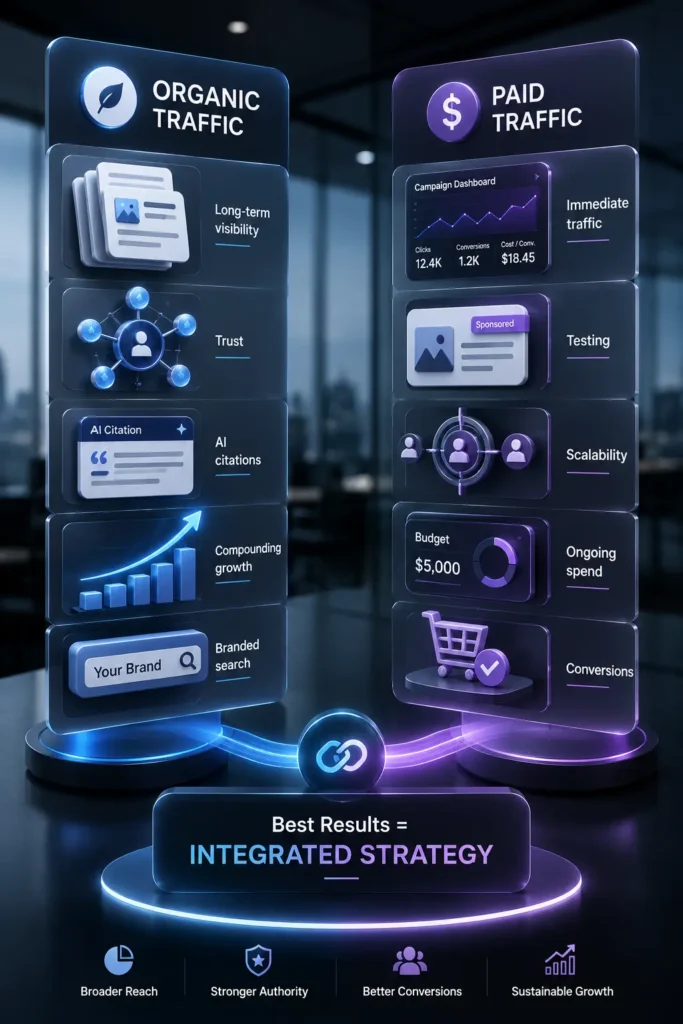
Organic visibility in the market leads to long-term discoverability for your business. On the other hand, paid traffic enables your company to reach users and acquire customers immediately.
The myth that Search Engine Optimisation (SEO) and paid traffic are separate channels with isolated purposes is just that, a myth. Both channels can be used to target customer behaviour at different points in the customer journey. In addition, both channels can be used to service a variety of goals. For example, organic search is often better for awareness and research-stage behaviour, whereas paid search is preferred for higher-intent users closer to conversion. Businesses also use paid retargeting campaigns to re-engage visitors who previously interacted with their website but didn’t convert.
| Factor | Organic Traffic | Paid Traffic |
|---|---|---|
| Speed | Slower to build | Immediate visibility |
| Sustainability | Compounding over time | Depends on ongoing spend |
| Trust | Higher perceived credibility | Advertisement-labelled |
| Scalability | Content and authority dependent | Budget dependent |
| AI Overview Visibility | May still gain citations without clicks | Limited to ad placements |
| Long-Term Cost Efficiency | Often improves over time | Costs continue indefinitely |
Why Organic Traffic Compounds Over Time
The biggest advantage of building organic visibility is that published content continues to earn impressions for authoritative content on relevant topics long after it goes live. One great piece of content can continue to drive traffic, earn backlinks and citations, and rake in branded search impressions for three years or more.
Understanding how SEO impacts your website goes beyond driving website traffic; it also improves your discoverability on other platforms. As more websites build out topical breadth of content and deeper content structures, they will surface in more search results surfaces, such as the blue link directly to the page, a brief AI-generated summary of the content, or even just a highlight from the content in another environment.
And while many businesses still overlook the value of organic traffic, it brings way more than direct visitors. It can also build awareness and trust, and even drive conversions as people become familiar with your brand, even if they aren’t actively looking to make a purchase at the time.
Why Paid Traffic Still Performs Well for Immediate Acquisition
Paid traffic is particularly valuable when you need to quickly inject traffic into the system to support a demand generation initiative. Paid channels can drive high-quality traffic to a site in order to support the launch of a new service or a time-sensitive campaign. Additionally, paid channels can serve as a control group for testing and validating high-converting funnels.
While organic efforts may be harder to attribute in the short term, paid efforts (e.g., Facebook, Google AdWords) allow monitoring for short-term attribution based on Ad spend per impression, click, conversion, and return on ad spend by campaign name/structure.
One of the biggest benefits of running paid traffic is the high predictability of scaling visibility for a brand or product. Even with a relatively modest investment, sufficient tuning of targeting or optimisation of creative generally makes it possible to scale traffic rapidly to keep up with the demands of a growing brand.
For example, companies frequently use Google Ads campaigns to test audiences and messaging with smaller budgets before investing in campaigns with stronger conversion rates. The real-time performance data provided by paid platforms enables easy optimisation for clicks, leads, or conversions, often faster than many organic channels allow.
Why Traditional SEO vs PPC Thinking Is Becoming Outdated
Traditional metrics such as rankings, clicks and direct traffic for SEO compared to paid search are no longer enough to accurately gauge the performance of SEO efforts against paid search efforts as businesses increasingly compare SEO vs AI SEO approaches and how visibility behaves across AI-driven search environments.
A new Pew Research study found that users are less likely to click on traditional search results when those results are accompanied by an AI summary. Users clicked on standard search links just 8% of the time when an AI summary was present, compared with 15% when no summary was provided.
Such research concludes that AI-driven features such as citations, summaries, snippets & search retrieval have a direct influence on the decline in direct traffic. These statistics prompt businesses to rethink the way they evaluate SEO performance.
How AI Overviews Are Changing Organic Click Behaviour
AI Overviews provide all the necessary information on the topic at hand, cutting search time by a multitude.
This claim is backed by data from Similarweb, which shows that the proportion of zero-click searches is rising as AI-powered summaries serve up answers to informational queries without displaying the traditional results page. Furthermore, the data reveals that many of these zero-click searches would otherwise have spawned multiple results pages, and users would have visited those sites before finding the answer.
And still, organic visibility is far from dead. People can still be found, cited, and have their brand reinforced online, even if that visibility doesn’t necessarily translate into clicks.
What has changed, though, is that when they start exploring how to rank in Google AI Overviews, businesses quickly realise you can no longer just look at click-through volume.
Why Visibility and Traffic No Longer Correlate Perfectly
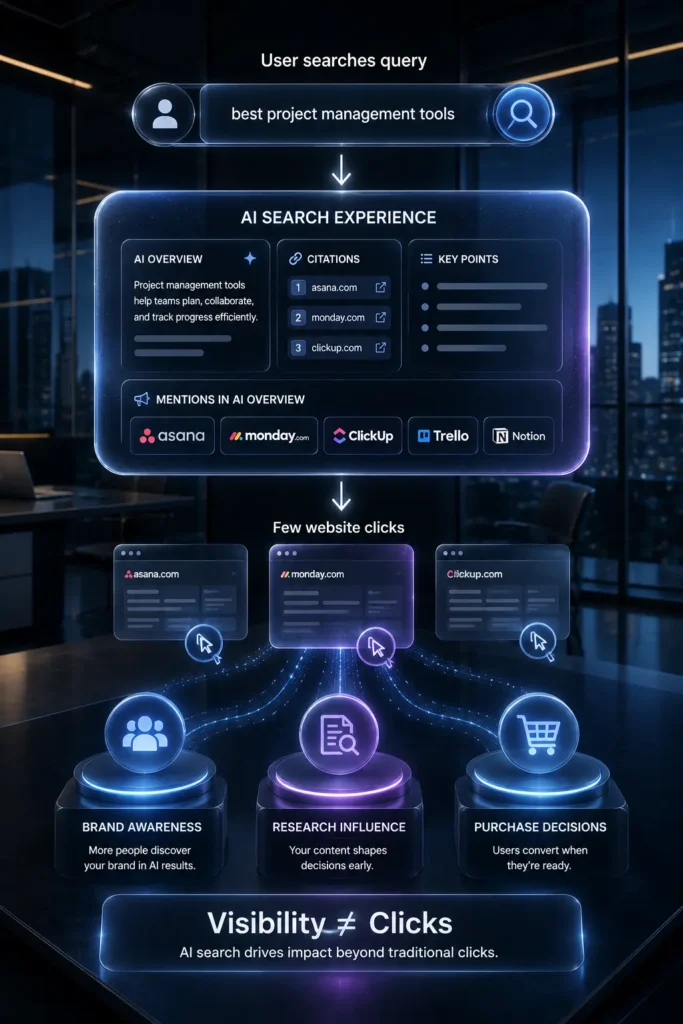
Strong organic rankings have historically correlated with website traffic. However, AI-generated search experiences increasingly provide answers directly within search interfaces, weakening the traditional relationship between visibility and clicks.
AI visibility may still influence users by:
- reinforcing topical authority
- appearing in AI-generated summaries
- increasing branded searches
- supporting research journeys
- influencing purchase decisions
Even when a user does not visit your website, your visibility in search results can still influence their search behaviour.
The drop in click-through rates often serves as a negative indicator; a decline in CTR does not necessarily mean a decline in influence. A website can achieve strong visibility in AI summaries, citations, and the wider search environment, yet still see lower CTR than before.
As search behaviour shifts, it is becoming increasingly common for businesses to move beyond rankings and explore concepts associated with LLM SEO, including entity recognition, topical authority, citation visibility, and assisted conversions.
Why Businesses Increasingly Need Both Organic and Paid Visibility
Organic and paid visibility increasingly function as complementary acquisition systems rather than competing strategies. Organic visibility is suitable for building long-term visibility, establishing a brand’s authority, and driving behaviour during the research stages of a purchase. Paid visibility, on the other hand, can drive an immediate increase in in-the-moment conversions and allow for testing of messages, audiences, and conversion performance.
Both channels can have their limitations. Companies relying solely on paid search risk rising acquisition costs as the number of advertisers on various advertising platforms and their respective bidding strategies continue to grow. Research on the auction dynamics and corresponding bidding mechanisms has shown that digital advertising markets are becoming less efficient over time.
As such, many companies derive their greatest value from combining organic visibility to build trust and long-term discoverability and paid campaigns to quickly acquire customers, retarget users and scale up in the short term.
Final Thoughts
Organic traffic and paid traffic continue to have different strategic objectives, with organic visibility growing over time and allowing for long-term discoverability whilst paid traffic allows for instant user acquisition and campaign control. However, search is now increasingly becoming AI-driven.
As AI-powered search experiences like Google AI Overviews and zero-click behaviour continue to transform consumer search behaviour, visibility presents a much broader light. In AI-driven search environments, organic search visibility, paid search visibility, and overall search visibility will interact in new ways – through factors such as citations, organic search visibility, brand or organisation authority, and, most importantly, conversions – both assisted and direct. Businesses will therefore benefit from analysing their search visibility strategy with these evolving interplays in mind and how they impact existing online acquisition objectives.
About The Director
Notable Achievements

Struggling to Attract More Traffic?
Let us help! We provide various digital marketing services that can easily rank your website on the first page of Google such as:
Allow your website to be seen by more users by scheduling an appointment with us today!