
The rise of Google’s AI Overviews and LLMs such as ChatGPT and many other conversational AI solutions that allow users to search online in a conversational way is prompting more businesses to question whether SEO is still a thing in 2026.
While the way that people search for information online is changing dramatically thanks to the rise of AI, that does not mean that SEO is dead. On the contrary, the way in which search engines rank pages is actually evolving to place greater emphasis on key factors, including structured information, topical authority, the relationships between pages, and, most importantly, extractable content. This is also why many businesses are now exploring broader AI SEO services as the new, more advanced version of traditional SEO.
Why Businesses Think AI Could Replace SEO
This concern is not baseless.
Changes in search behaviour now mean users are conducting question-type searches and going straight to AI-powered services such as Google AI Overviews, ChatGPT, Perplexity, and other new conversational search services for answers. The nature of the question lends itself perfectly to these services, as they provide the most direct answer. This type of service also naturally reduces the number of clicks the user needs to find other answers to such questions on the web.
This change in Search patterns is being driven by Google itself as they roll out Google Search, which includes AI-generated summaries and an AI-assisted search function as part of the main Search product.
There are many debates in the SEO subreddit about the future of SEO, how AI will change it, and whether it will decrease organic traffic. People believe that AI will make SEO much easier to scale, but it will also make most of an SEOer’s work redundant.
Even more recently, Google AI Overviews have been creating summary answers to users’ questions without ever linking to another web page that contains the answers.
The structural implication is significant:
SEO is no longer operating within a purely “10 blue links” environment.
Why AI Still Depends on Websites and Structured Content
Despite the rise of AI-generated answers, AI systems still rely heavily on websites as sources. Large language models retrieve, compare, and synthesise indexed content rather than generating information independently.
Websites remain foundational because AI systems rely on trusted sources, semantic relationships, and retrievable passages to surface answers. For example, Google AI Overviews synthesise information from external web sources to generate summaries and recommendations within Google’s evolving AI search ecosystem.
This is also why structured content matters more. Clear headings, semantic consistency, and topical depth improve how information is interpreted and retrieved across AI-driven systems.
Major SEO platforms such as Semrush’s future of SEO analysis increasingly frame SEO around AI visibility rather than rankings alone.
What AI Is Actually Replacing in SEO
Repetitive tasks in SEO are now being carried out by AI such as generating metadata, keyword clustering, templated informational pages & basic content creation.
Most importantly, search engines are placing a greater emphasis on original content, authority, semantic depth and expertise. High-level strategic work such as brand positioning, audience understanding, conversion-focused page architecture and prioritisation of content by topic are not yet automatable.
Ultimately, it’s the businesses with the strongest topical authority and most developed visibility structures that will succeed in the long run over the SEOs churning out more and more content to rank more and more stuff.
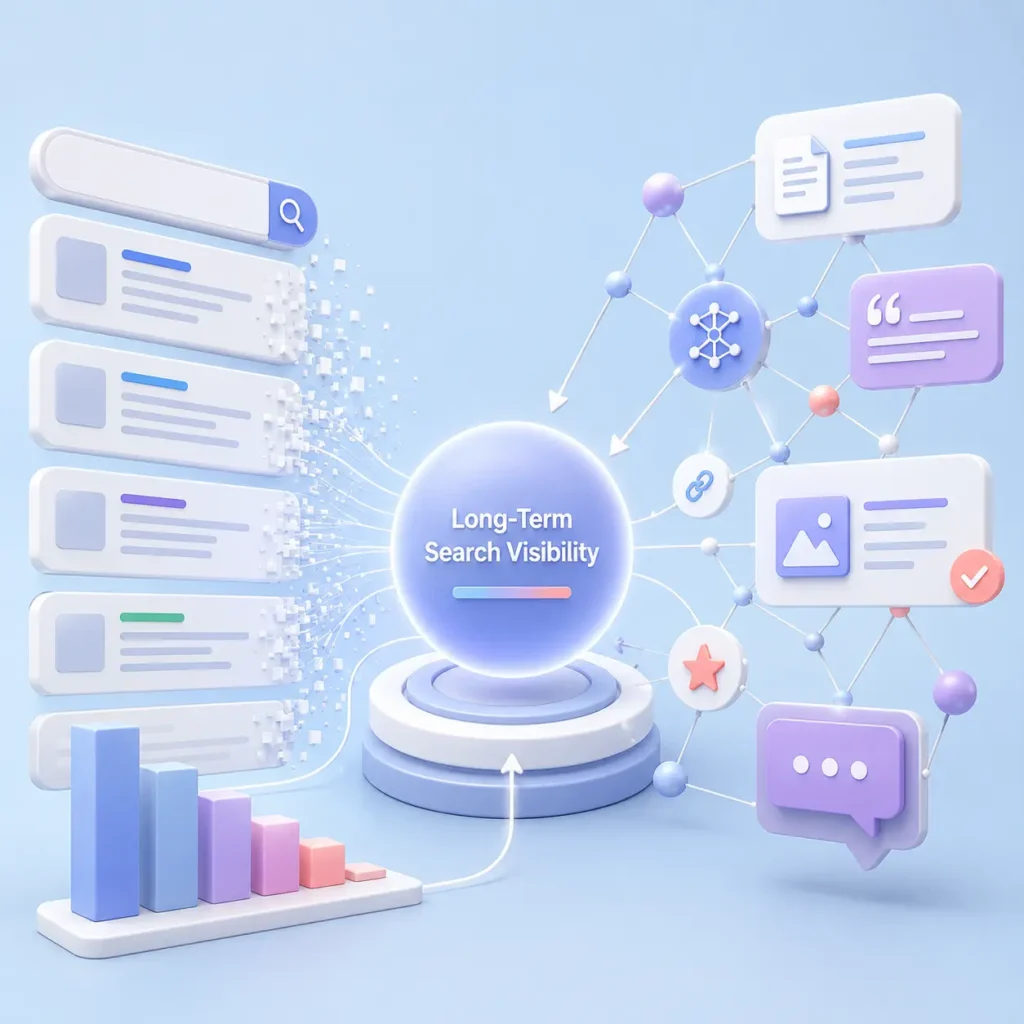
SEO Is Shifting From Rankings to Retrieval

One of the biggest changes happening in SEO is the shift from rankings towards retrieval.
Traditional SEO focused heavily on keyword rankings, SERP positions, and organic clicks. AI-driven search systems increasingly operate differently, placing greater emphasis on retrieval, entities, citations, and discoverability across AI ecosystems. Businesses trying to understand the distinction between traditional SEO vs AI SEO may notice that visibility is no longer determined solely by rankings.
Instead of simply ranking pages, AI systems increasingly retrieve passages, entities, definitions, summaries, and supporting context.
This changes how visibility works.
Your content no longer has to be visible at the #1 position (the old ranking positions). Now, already a retrieved passage, a summarised article, a defined term, linked citations, and even all the other information from the AI ecosystems can influence your visibility.
The shift towards retrieval is also driving growing interest in LLM SEO strategies focused on how large language models interpret and surface information.
| Traditional SEO | AI SEO |
|---|---|
| ✔Rankings-first | ✔Retrieval-first |
| ✔Keywords | ✔Entities + context |
| ✔Blue links | ✔AI summaries + citations |
| ✔Clicks | ✔Visibility + assisted conversions |
| ✔Search engines | ✔AI ecosystems |
The structural implication here is important:
SEO is no longer only about ranking webpages. It is increasingly about becoming retrievable across AI-driven systems.
Why Traditional SEO Metrics Are Becoming Less Reliable
Changes in search experiences, such as different experiences on different devices, in different locations, with different user behaviour, make traditional SEO metrics more difficult to read. Moreover, summaries generated by AI and conversational interfaces also unpredictably affect rankings and CTRs.
However, rankings are only one part of the equation when it comes to SEO metrics. For example, in addition to rankings, other factors affect a page’s success. The rise of AI answers, featured snippets and AI-generated Search Overview results, for example, is leading to more results being returned directly within Search, which means that visibility and traffic are no longer 100% correlated. This can cause CTR, rankings, and zero-click search and impression values to fluctuate, even when impressions remain constant. And as recently published research into search behaviour has found, a growing number of searches are ending without a visit to a website — so-called zero-click searches.
What Businesses Should Focus On Instead in 2026

Businesses likely to perform best in AI-driven search environments are usually those that build stronger foundations rather than chase short-term SEO tactics.
Build Topical Authority
There is a growing number of AI systems that are analysing and ranking websites, not by their content, but by the depth of topics related to other content on the web.
Instead of publishing isolated articles and blog posts, it’s better to create topic-based ecosystems showing your strength and expertise in an area. Search engines are beginning to understand the concept of topical authority and how it helps them to understand, index and rank content appropriately.
Improve Entity Clarity and Semantic Structure
Search engines and AI are starting to look at brands in a whole new way. Traditional models that relied on simple keyword analysis are no longer sufficient. Now brands are viewed as complex objects: collections of attributes and relationships, embedded in contexts and distributed across the web.
For an AI to understand what your business and organisation do, the semantic structure/terminology must be clear and consistent. Also, for there to be adequate internal links.
Create Content That Is Easy To Retrieve
All content should be easily retrievable by non-traditional search engines. So when organising content within your site, well-organised content with clear section headers, adequate descriptions, and suitable organisation will outperform ‘packed’ content of similar size, even where much of the content contains the same keywords over and over in attempts to enhance search results.
Focus on Visibility Beyond Rankings
Search visibility is no longer just about ranking in the SERPs.
As AI increasingly affects search results, business leaders are no longer just interested in their ranking. They are more interested in how their site and content are being discovered, their growth in branded search, assisted conversions, AI citations and engagement quality.
Strengthen Technical Foundations
Technical SEO remains important because AI systems still rely on crawlable, interpretable, and structured websites.
The AI revolution for search is just around the corner. As such, strong site architecture & organisation, site crawlability, the use of structured data, fast site speeds, and a good mobile experience will continue to be key.
Final Thoughts
While AI is unlikely to eliminate SEO from the marketing mix, it will definitely change how brands perceive online positioning. Google and other AI-powered search engines index and rank results differently and many companies are questioning whether they are tackling their digital brand strategy efficiently. Contact us for a free site audit if you’re looking for long-term and sustainable SEO results
Frequently Asked Questions (FAQs)
Will AI replace SEO completely?
AI is unlikely to replace SEO entirely because AI systems still rely on websites as source material. However, AI is changing how visibility is earned by prioritising extractable, authoritative, and contextually relevant content.
Is SEO still worth it in the Age of AI?
Search engine optimisation is still relevant in 2026 — it’s just the way that search engines rank results is changing to ensure that the most relevant results surface for any query.
What is the difference between traditional SEO and AI SEO?
Traditional SEO focuses on rankings and organic traffic. On the other hand, modern SEO requires optimisation for retrieval, citations, entity recognition, and visibility in what we’re calling “AI SEO’d search environments” such as AI Overviews and even conversational AIs that allow users to chat out their questions.
Does ranking #1 on Google still matter in 2026?
Ranking #1 remains valuable, but visibility increasingly extends beyond traditional rankings. AI Overviews, conversational search, and retrieval systems may surface content even when pages are not in the top position.
About The Director
Notable Achievements

Struggling to Attract More Traffic?
Let us help! We provide various digital marketing services that can easily rank your website on the first page of Google such as:
Allow your website to be seen by more users by scheduling an appointment with us today!