
Often SEO works like practice for perfecting a presentation but because of AI Overviews and zero-click SERPs, we had to test that on our own site, not on a slide for a client presentation.
We treated theleadingsolution.com as our own test lab, using the same Search Console, the same Singapore market and that urge to publish more quality content. We decided to measure what our own pages were earning in impressions and attribute changes to them accordingly.
To begin with, we focused on the top 100 pages of theleadingsolution.com. 350,189 impressions were logged by Google Search Console for the 11 May to 10 Aug 2026 time frame. There were 105 clicks for a 0.030% click-through rate (CTR).
This post is NOT another piece on how zero-click is the future of search. Rather it describes our analysis of our top Singapore property pages by impressions and how we then assigned actions to those pages (keeping/updating/merging/monitoring/pruning) as we overcame our misdirected focus on ranking rather than snippets.
How we measured it
For these headline numbers, we extracted the top 100 pages over a three-month window using Ahrefs’ GSC connection to Search Console (the same data behind the interface). We specified exporting “All countries” vs “Singapore” (the constraint we wrote down on a sticky note) and stuck to it for the numbers below, which cover 11 May to 10 Aug 2026.

That tagging frame is the same one we use in a structured SEO audit and in the fingerprint work behind content decay vs AI Overview click loss. Decay is a ranking and impression slide. On several page-1 rows we saw something different: position held, impressions arrived, clicks did not.
We decided not to open the sitting by writing more blog posts. The library already had supply. The question we asked ourselves was whether the SERP was paying us for the impressions we had already earned.
Finding 1 — five page-1 rankings, zero clicks between them
Five of our URLs sat near page 1 for meaningful queries and still returned zero clicks. We decided to lock a fresh 28-day period for a snippet experiment (about 9 August–5 September 2026):
| URL | Avg. position | Impressions (28d) | Clicks | What the queries said |
| /services/ecommerce-seo/ | 9.97 | 2,194 | 0 | Top: ecommerce seo services/agency/ singapore (several at pos ~1–3) |
| /seo-methodology/on-page-seo/ | 7.35 | 145 | 0 | on-page seo singapore (78), onpage seo singapore (38) |
| /seo-methodology/off-page-seo/ | 11.41 | 58 | 0 | offpage / off page seo singapore |
| /resources/aio-services-for-singapore-businesses/ | 16.74 | 249 | 0 | best aio services in singapore at pos 1.24 — still 0 clicks |
| /resources/seo-for-small-business/ | — | 0 | 0 | No Performance rows in the lock window |
For /services/ecommerce-seo/ in our longer audit (May to August), it landed at position 7.1 for “seo singapore” with 6,202 impressions but 0 clicks. We consider this an intent mismatch, which we mistook for a sign of strong ranking. This e-commerce SEO service URL was competing with other generic SEO agency results for users searching for ‘SEO in Singapore’-related queries. The existing title and meta described ‘top-notch ecommerce SEO’ and a free audit, which didn’t match the search intent of our target audience.
At first, we read the zero clicks as an extractability problem. A check on the live SERP for Google Singapore (google.com.sg, logged out) showed an AI Overview on “seo singapore,” plus sitelinks, a Map Pack listing, and even a competing title that matched the query better than our own. Where an Overview was present, we applied the approach in how to rank in Google AI Overviews to make the relevant part of the page more extractable. Where there was no Overview and we still weren’t getting clicks near the top of page 1 for the related searches, we tested changing the title tag first.
Note that we didn’t put the /resources/seo-price-singapore/ page in this section, as the impressions on that page were deep, but the average position was very poor (~54.7 from the brief export). That’s a different failure and hence, requires a different fix.
Finding 2 — the money page with 152 referring domains at position 37
/services/seo/ is the money page for the site. It has 152 referring domains according to Ahrefs data, and in GSC we see it ranking around average position 37.0 for 4,747 impressions in the same story window, with zero clicks.
This strong link plus soft average position does not equal “write more”. In our case, on this property, it is showing dilution – either the paginated duplicates in the service cluster, thin copy variations or even a silo that dilutes equity. Our first suspicion would be the /services/ai-seo-services/page/2/ through /services/ai-seo-services/page/4/ indexable pagination.
This finding was deliberately left out of the five-page snippet test because, for example, a meta rewrite to turn a position-37 money page into a position-4 page would be irresponsible until after the CTR window had passed. We’ve marked pagination and internal linking for updating here.
Finding 3 — Keep was empty
The report shows that Keep = 0 for the top 100 pages — none of them sat at average position 4 or better on the pass we tagged.
This is what our chart for the top 100 looked like after that pass. Not only did it support the shareable that the 80/20 rule in SEO stops being a slogan at some point, but also almost all of our impression weight was outside of the top 4 spots, and thus “publish more” would only add Monitor and Update rows to that. In order to concentrate the equity and clarify on the handful of URLs that were actually going to win queries, we chose to focus our hours on Update (35) and Merge (14 across 12 groups). Prune (3) was relatively a minor action. The empty Keep bucket wasn’t because of lack of a content calendar — that wasn’t the problem.
What we decided to change — and in what order
We set a sequence before we touched WordPress:
- Titles and metas first on the five zero-click URLs only — cheap, measurable in about 28–35 days, aligned with how Google documents title links.
- Merges second — after the snippet window, so we do not confound the CTR test.
- Money-page diagnosis third — pagination/silo on /services/seo/, not another blog.
That order is continuous optimisation as we run it: change one lever, measure, then touch structure.
The five snippet edits we shipped
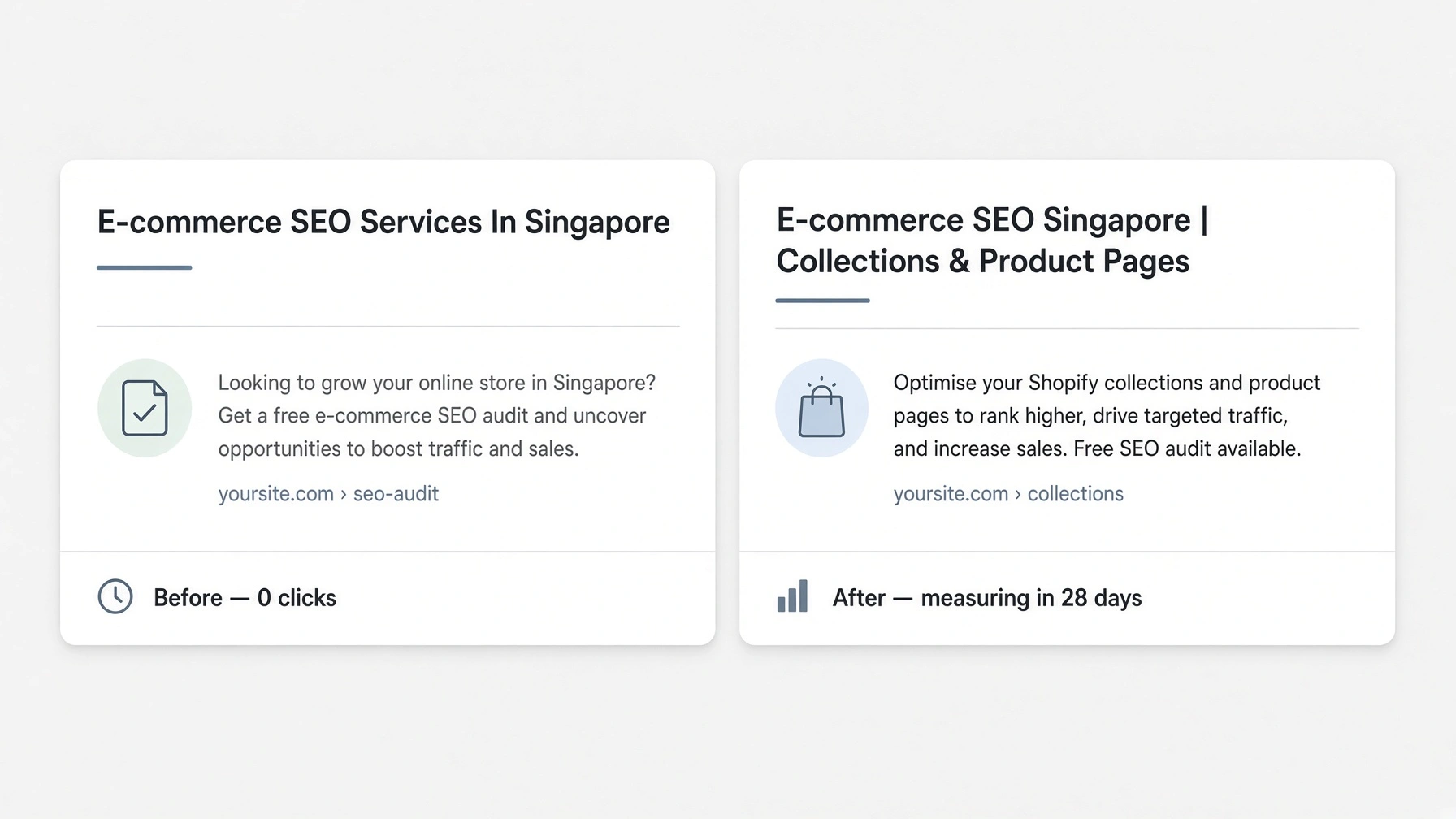
The before-and-afters were organised before we went live:
| URL | New title | New meta |
| /services/ecommerce-seo/ | E-commerce SEO Singapore | Collections & Product Pages | E-commerce SEO for Shopify and WooCommerce stores in Singapore. We fix collections, product pages and crawl waste so organic search turns into orders. |
| /seo-methodology/on-page-seo/ | On-Page SEO Singapore | Fix Pages That Already Exist | On-page SEO as we run it: titles, intent, internal links and snippet tests on pages Google already knows — not another definition of title tags. |
| /seo-methodology/off-page-seo/ | Off-Page SEO Singapore | Links That Still Move Rankings | Off-page SEO without PBNs: relevant links, brand mentions and a clean profile for Singapore sites after Google spam crackdowns. |
| /resources/aio-services-for-singapore-businesses/ | AIO Services Singapore | Show Up in AI Overviews | AIO for Singapore businesses: structure pages so Google AI Overviews can cite you — not bury you under a summary nobody clicks. |
| /resources/seo-for-small-business/ | SEO for Small Business Singapore | What to Do First | SEO for Singapore SMEs: which pages to fix first, what to skip, and how to read Search Console when impressions bring almost no clicks. |
We decided not to mix merges, pagination fixes, or new posts into the same 30 days. We wanted a clean before/after on snippets alone.
What we are measuring next
Those five titles and metas are live. The table below is the locked before from Search Console (~9 August–5 September 2026, All countries). We will fill the after columns in 28–35 days on the same property, same filter, and the same five URLs — then update this section with real results. Until then, this stays an audit essay of what we decided and what we shipped, not a finished experiment write-up.
| URL | Primary query | Before impr | Before clicks | Before CTR | Before pos | After impr | After clicks | After CTR | After pos |
| /services/ecommerce-seo/ | ecommerce seo singapore | 2,194 | 0 | 0% | 9.97 | — | — | — | — |
| /resources/aio-services-for-singapore-businesses/ | best aio services in singapore | 249 | 0 | 0% | 16.74 | — | — | — | — |
| /seo-methodology/on-page-seo/ | on-page seo singapore | 145 | 0 | 0% | 7.35 | — | — | — | — |
| /seo-methodology/off-page-seo/ | offpage seo singapore | 58 | 0 | 0% | 11.41 | — | — | — | — |
| /resources/seo-for-small-business/ | — (no rows) | 0 | 0 | — | — | — | — | — | — |
How we ran that sitting
Inside the audit hour we:
- Opened Search Console Performance → Search results → Pages.
- Set a 3-month range and noted the country filter.
- Sorted by impressions descending and exported CSV.
- Flagged our own URLs with high impressions + near-zero clicks and average position ≤10 as snippet candidates.
- Separately flagged high-authority / soft-position money pages and refused to “fix” those with a title tag alone.
- Tagged Keep / Update / Merge / Monitor / Prune on the top 100 only. Empty Keep stopped any content-sprint talk until we knew why.
The pattern we hunted: impressions flat or up, clicks down, position stable — and page-1 rows that never earned the click because the snippet sold the wrong job.
Why we decided not to publish more content first
Our website already had hundreds of indexed URLs. While the top 100 pages produced the bulk of our impressions at a third of a million+, average click-through rates were near zero. In essence, extra content would have added more Monitor rows but not, for example, renamed our e-commerce page ranking for “seo singapore,” nor cleared the paginated AI-SEO duplicates, nor rewritten the five failing click-test titles.
So we fixed the pages that Google is already showing and measured the change in snippet. The work to merge similar pages and sort out the money page can wait past the CTR window.
We’d love to provide you with the same insight into your own Search Console export — with the same buckets and filtered to just Singapore data. We’d start with a thorough SEO audit and go from there. Just get in touch.
About The Director
Notable Achievements


Struggling to Attract More Traffic?
Let us help! We provide various digital marketing services that can easily rank your website on the first page of Google such as:
Allow your website to be seen by more users by scheduling an appointment with us today!