
Have you had a URL whose impressions hold or rise and whose average position stays the same or improves? In most cases, it happens not because the page did not rot — the results page answered the query before the click. This drop in organic clicks is attributed to AI Overview click loss.
That is not content decay. Decay is a ranking and impression slide over months. Mixing the two is how a marketing manager in Singapore rewrites page one on google.com.sg — and then wonders why the clicks do not return.
This article is only the diagnosis. Filter Search Console to Singapore. Read three columns. Decide which fingerprint you have. Then leave.
The two fingerprints in Search Console
Set the Performance report to Country: Singapore before you export. A global view mixes US and other traffic into the same line. You will misread a local how-to post because an overseas query moved.
Use 16 months, not 28 days. Compare year-on-year if the query is tuition, Great Singapore Sale, CNY retail or year-end festive. Then match the row to the table.
| Clicks | Impressions | Position | Diagnosis |
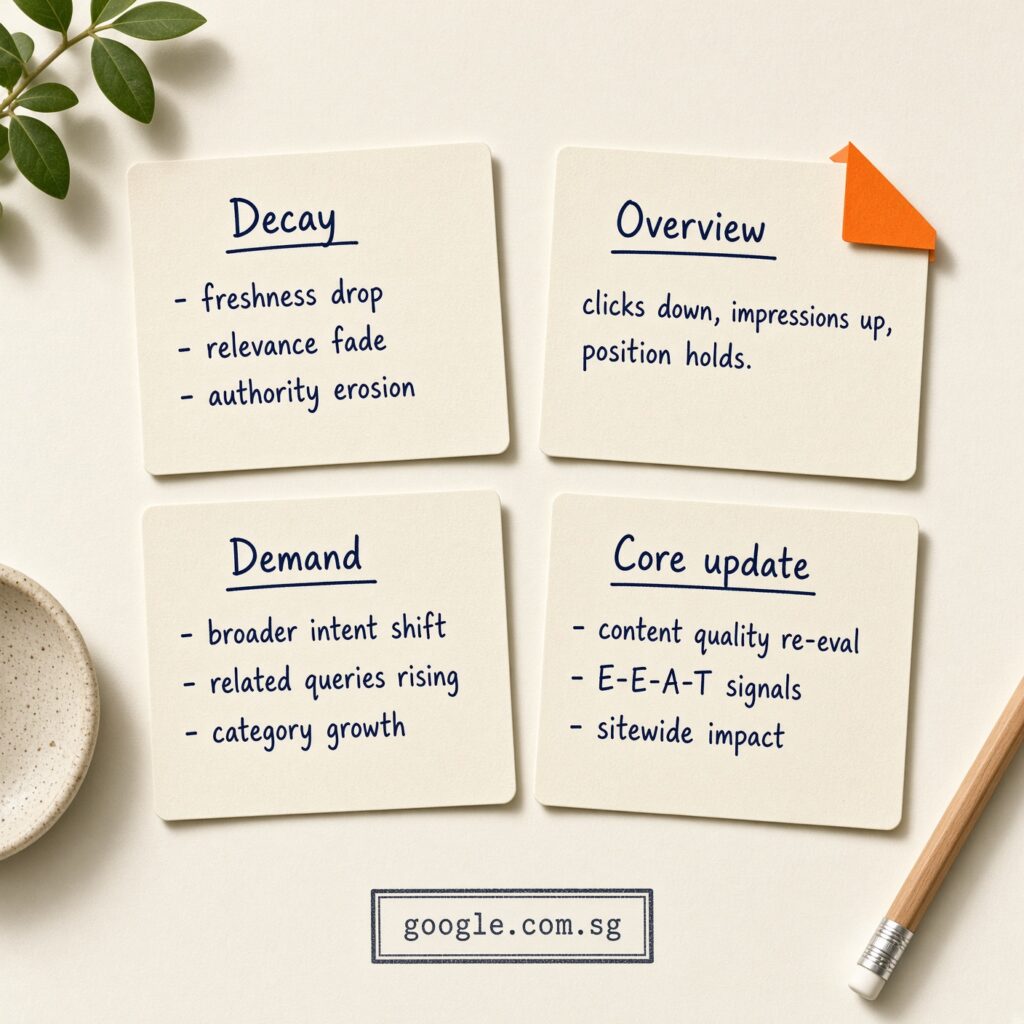
| Down | Down | Worse | Content decay — the page is losing the ranking. |
| Down | Flat or up | Stable or better | AI Overview click loss — zero-click capture. |
| Down | Down | Held or better | Demand drop — fewer people search the query. |
| Down, many URLs, same date | Down | Worse | Core update — not a single-page problem. |
Search Engine Land’s 2026 note on the types of content decay calls the second row zero-click capture. Ahrefs named the chart shape the Great Decoupling: impressions and clicks no longer move together when an AI Overview sits on the query.
What AI Overview click loss looks like on a Singapore SME blog
Informational English queries are where Overviews fire most often. That is most of a Singapore SME blog: what is GST, how to register a Pte Ltd, IRAS corporate tax dates, PSG eligibility, how tuition works before O-Levels. Commercial pages — “SEO agency Singapore”, “renovation contractor near me” — more often share the SERP with the Map Pack. The how-to posts take the Overview blow. The service pages take a different one.
Chinese and Malay queries on the same topic do not always show the same feature. Confirm the language the URL actually ranks for. Do not diagnose an English GST guide using a 消费税 results page.
In Search Console the chart looks like an open mouth. Impressions climb or hold. Clicks fall. Average position barely moves. The URL is still being shown to people searching from Singapore. Fewer of them leave Google.
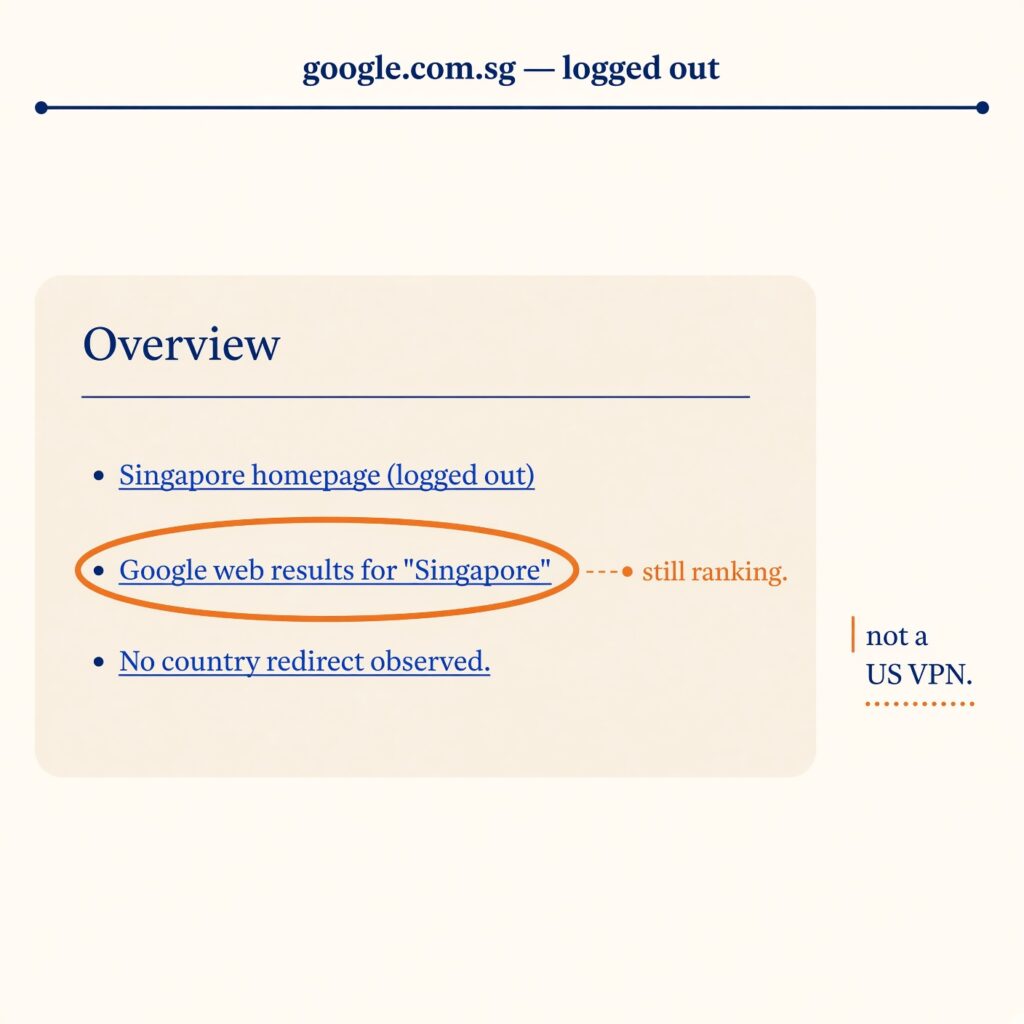
Confirm it on the results page before you act. Take the URL’s top query from Search Console. Search it on google.com.sg, logged out, from a Singapore connection — not a US VPN. If an AI Overview sits above the blue links and your URL is still in the pack, the fingerprint is closed. If there is no Overview and a competitor now occupies positions 1–3, you are back in decay.
What to do when it is content decay
If impressions fell and position worsened on the Singapore filter, the page is no longer the best available answer here. That is the job of the content decay buckets: Keep, Update, Merge, Monitor or Prune. This article does not retell those rules.
Run the sitting in the 90-minute content audit. Export 16 months with Country set to Singapore. Tag the URL. Then update or merge. Do not start that sitting if the only thing that moved is clicks.
What to do when it is an AI Overview
Do not rewrite the H1 because clicks fell. Do not 301 a URL that still ranks on google.com.sg. You did not lose the ranking. You lost the click to the summary at the top of the results page.
The work is to become the source that the summary cites. That playbook already lives in how to rank in Google AI Overviews: a direct first sentence under each heading, facts that can stand alone, a page that names SGD, the right agency and a Singapore use-case so the Overview has something local to lift. This article stops at the diagnosis so that playbook is not copied here.
A stale page can still be cited for a while. Then it is replaced — often by a fresher .sg source. If you want the citation to persist, the URL has to stay current. That is maintenance, not a new post on the same query.
The trap
Specifically: today we trace a huge click loss on an AI Overview page as being tagged “Update” or “Prune”.
- You update a page that is ranking and earning good positions on google.com.sg after hours of rewriting, and the page still loses clicks because the Overview keeps them on the results page.
- You would delete a URL that is still earning impressions in Singapore informational searches — and this could be the most-cited page in your tutorials.
- By merging two URLs that both lost clicks on the same informational queries, you’ve created a single URL that will continue to lose clicks. All you’ve added is the 301 to maintain.
Clicks on a page can drop overnight, but impressions and position will tell you what happened on Google Singapore specifically once you’ve filtered for that.
What a first read looks like
On our own resources library, Keep sat at zero in August 2026. That Keep figure is no aid here: some of our how-to posts still sat on healthy Singapore impressions with softer click-through. It is the same Ahrefs fingerprint for informational queries when an Overview is present — keep the page extractable, not deleted.
A Singapore tuition centre with 224 indexed pages may show both in the same export: decaying subject guides (position 6 to 18) and Overview-loss pages (held at position 7, impressions up, clicks down). Education queries in Singapore are seasonal and informational. Year-on-year analysis masks the exam spike. The Overview fingerprint typically remains after seasonality is stripped out. If all you have is a month’s data, you cannot tell seasonality from zero-click capture — you will call it all decay and change the wrong pages.
When to run the 90-minute audit anyway
The fingerprint does not replace the audit. It stops you mis-tagging one column. Once you know which rows are Overview loss, the rest of the library still needs the content audit sitting: export, tag, links check, merge groups — Country still set to Singapore.
Mark Overview-loss rows as Monitor, not Prune. Review them in 90 days. If position then worsens and impressions fall, they have crossed into decay. If position holds, leave the URL and work on extractability.
FAQs
How do I tell content decay from an AI Overview in Search Console?
Filter the Performance report to Singapore, then open the URL for 16 months. If clicks are down, impressions are down and position is worse, it is content decay. If clicks are down, impressions are flat or up and position is stable or better, it is AI Overview click loss.
Why are my impressions up and clicks down?
Impressions up and clicks down usually means the URL is still being shown to Singapore searchers while an AI Overview, featured snippet or similar result-page answer is taking the visit. Ahrefs calls that split the Great Decoupling. It is not proof the writing failed.
Should I rewrite a page that lost clicks to an AI Overview?
Do not rewrite it to chase the old click curve. Keep the URL. Make the first sentences extractable so the Overview on google.com.sg can cite you. A full rewrite is for decay — when position and impressions have also fallen.
Do I need to search from Singapore to confirm this?
Yes. Confirm the top query on google.com.sg from a Singapore connection, logged out. A US VPN will show you a different SERP and a different Overview.
Conclusion
Clicks fell. Filter Search Console to Singapore. Read impressions and position before you touch the page. Content decay is a ranking slide. AI Overview click loss is a results-page slide. One gets an update or a merge. The other gets left in the index and written so it can be cited.
A Singapore SME blog featuring articles on GST and Pte Ltd, such as explaining the differences between a company and a sole proprietorship, as well as guides to tuition for students for various subjects and a simple calendar for booking an appointment in between CNY and the exam window, for instance. Most of the “our traffic died” charts floating around on the net are of the second type, or fingerprint. We run a read on this for you at The Leading Solution. Contact us through the contact page.
About The Director
Notable Achievements


Struggling to Attract More Traffic?
Let us help! We provide various digital marketing services that can easily rank your website on the first page of Google such as:
Allow your website to be seen by more users by scheduling an appointment with us today!